
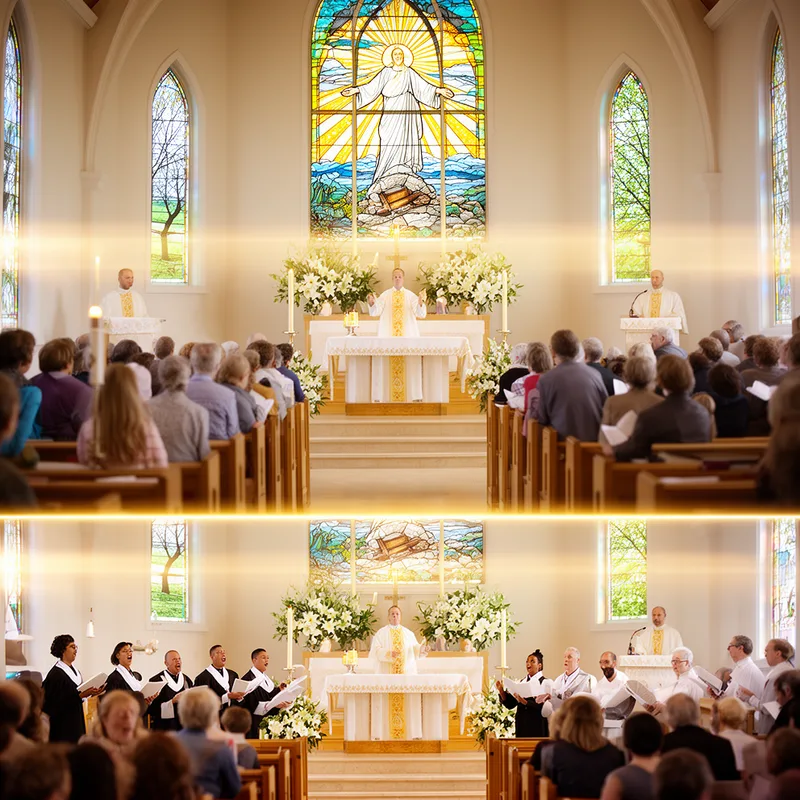
Eastertide
 1
9.8

- noun
- /ˈiːstərtaɪd/
- Formal
- The last time I was in London was at Eastertide many years ago, and I attended the Easter vigil there at the Russian Orthodox cathedral in Kensington.
Examples
-
All these perspectives should be and must be heard to get the full Scriptural picture of Our Lord, and this full perspective is offered in the OF Lectionary: Matthew in Year A, Mark in B, Luke in C, and John at Eastertide and in B when Mark is too short.
Blog text (31) -
The season of Eastertide lasts for 50 days, culminating in the celebration of Pentecost.
-
I will begin on Holy Thursday in the Christian year 1487, Eastertide for the Christians, Passover for the Jews, a perilous time for all.
Fiction book (1998) -
On March 13, 1573, Maria was desperate enough to invoke the impending Eastertide.
Academic text (1999) -
No Mass was arranged for Pope Benedict to celebrate during this Eastertide on the site of Christ's resurrection, but a Mass for a capacity of 6,000 was set up outside the walls near the Basilica of Gethsemane.
Blog text (28) -
Eastertide is a joyful time when Christians celebrate the Eastertide of Jesus Christ.
-
During Eastertide, many families gather to reflect on their faith and attend church services.
Surface Forms
Morphology
Eastertide = Easter + tide (semi-transparent) = Easter + tide
Combines the familiar 'Easter' with the archaic/poetic 'tide' meaning 'season'; 'tide' may be unfamiliar or misinterpreted by learners as the sea tide.
Etymology
Eastertide is made of Easter and tide, where tide once meant 'time' or 'season', as in yuletide. So Eastertide means the 'season' after Easter when Christians celebrate the resurrection of Jesus.