
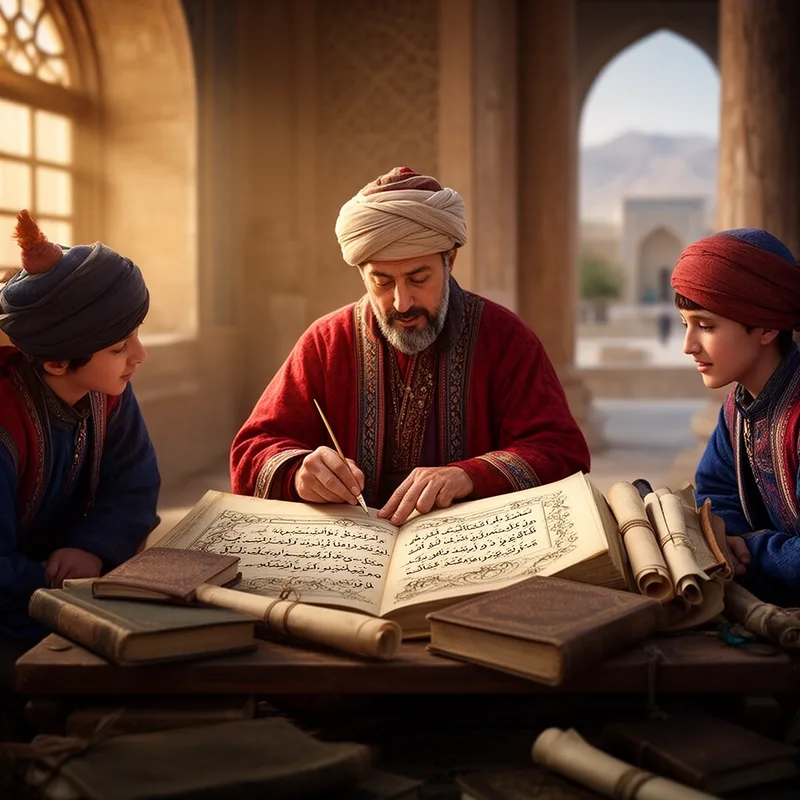
Eastern Turki
- noun
- Archaic
- Scholars have found many manuscripts written in Eastern Turki in the region of Xinjiang.
Examples
-
The epic poetry of Eastern Turki greatly influenced later Central Asian literature.
-
He spent several years learning Eastern Turki to study ancient texts.
-
The Eastern Turki language has a rich literary history.
-
Many scholars study Eastern Turki to understand its cultural significance.
-
Scholars have found many manuscripts written in Eastern Turki in the region of Xinjiang.
-
He spent several years learning Eastern Turki to study ancient texts.
-
The epic poetry of Eastern Turki greatly influenced later Central Asian literature.
Synonyms

A medieval written Turkic language from Central Asia used in regions once ruled by a son of Genghis Khan

A Turkic written language from Central Asia in the Middle Ages, named after Chagatai, a son of Genghis Khan
A written Central Asian language from the middle ages, named after a son of Genghis Khan

A written language used for books and poems in medieval Central Asia

A written Turkic language of medieval Central Asia named after a son of Genghis Khan
A written Turkic language used in Central Asia long ago

A Turkic written language used across Central Asia from the 1400s to the early 1900s
Surface Forms
Morphology
The phrase denotes the Turki language associated with eastern regions, so its meaning is directly and compositionally derived from 'eastern' (region) + 'Turki' (the language name). This adjectival location + language naming pattern is cross-linguistically common and contains no idiomatic shift, so a learner who knows both constituents can infer the meaning.
Etymology
Eastern Turki may come from a simple place idea: Turki was a word for a Turkic language and Eastern showed it was the form from the 'east' of the Mongol lands and Xinjiang long ago. So the name now refers to an old Turkic literary language used in Central Asia.

