
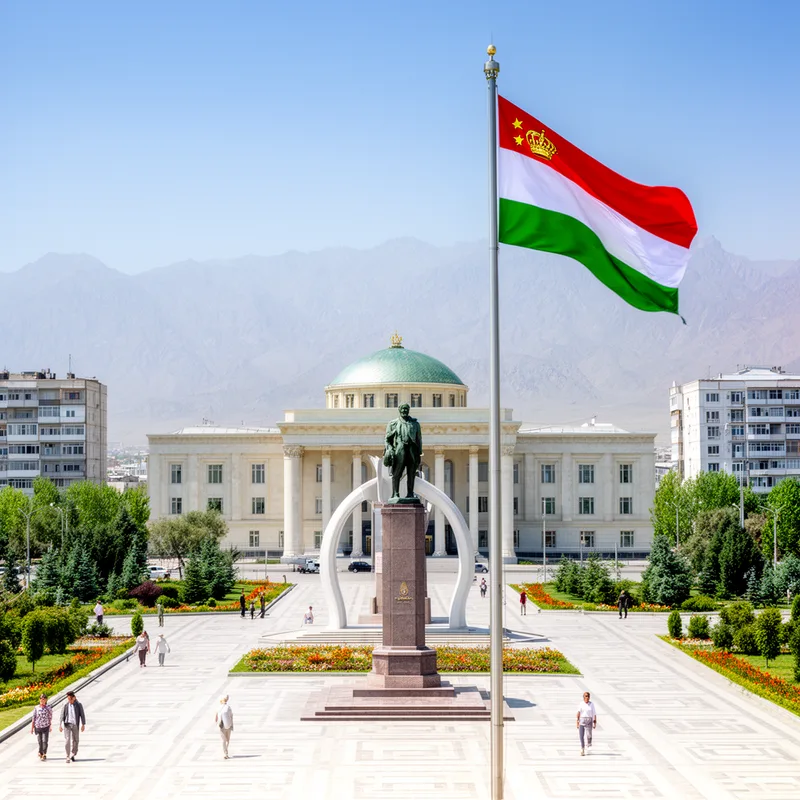
Dushanbe
 1
7.1

- proper noun
- /duːˈʃɑːmbeɪ/
- Forces loyal to him captured Dushanbe in October, but his replacement, Akhsbarshah Iskandrov, retained power for seven weeks thanks to the intervention of Russian troops.
Examples
-
Then, within one calendar month, the fall of Kabul, the coup in Dushanbe, and trips by Islamic leaders to Central Asia occurred.
Academic text (1996) -
Tourists visiting Dushanbe can explore beautiful parks and historic sites that reflect the city's rich history.
-
Russian forces did re-establish a pro-Moscow government in Dushanbe.
Academic text (1996) -
Dushanbe and Beijing also signed ten cooperative agreements for future economic projects, such as joint ventures in the textile industry.
Academic text (1996) -
With the outbreak of the civil war in Tajikistan, the party has been practically paralyzed, and its leaders have fled to Afghanistan in an effort to coordinate the armed struggle against the Communist regime in Dushanbe.
Academic text (1994) -
The party's request to hold its founding congress in the capital city of Dushanbe was denied by the Communist Party First Secretary Ghahar Makhkamov, forcing the 300 participants of the constituent conference to convene a meeting in a village outside the city.
Academic text (1994) -
Dushanbe is known for its stunning architecture and vibrant culture as the capital city of Dushanbe.
-
The government of Tajikistan is based in Dushanbe, where important decisions regarding the country are made.
Synonyms
The capital city of Tajikistan, formerly called Stalinabad, is in Central Asia
Surface Forms
Etymology
Dushanbe comes from Persian parts du and shanbe, which mean 'two' and 'day', so the name literally means 'Monday'. The town was named for a large 'Monday' market held there, which is why the capital is called Dushanbe.