
Durga
 4
9.5
4
9.5

- proper noun
- /ˈdʊrɡə/
- Literature
 :
Durga
:
Durga
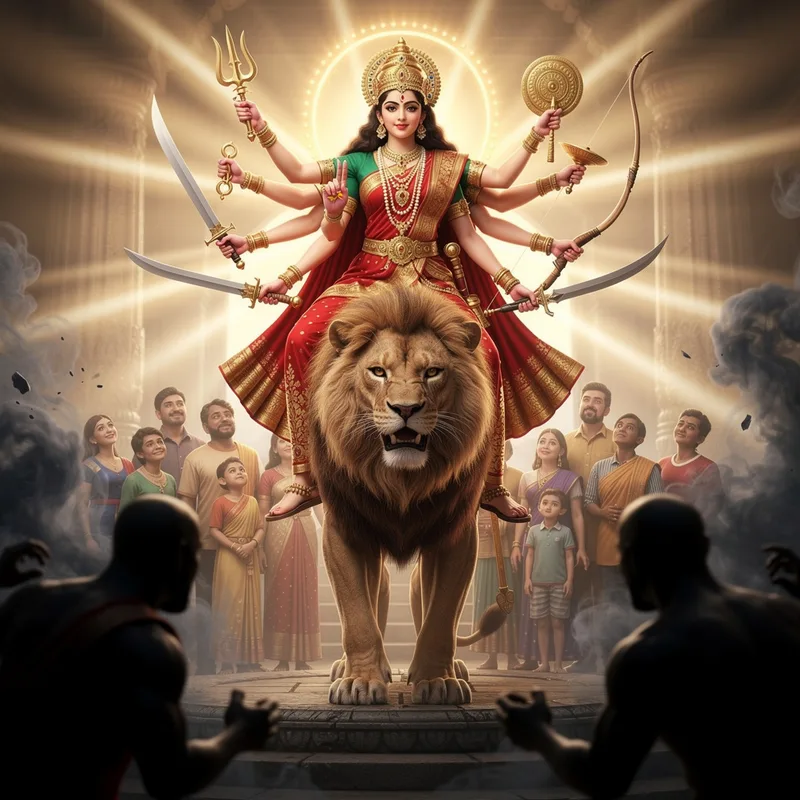
- A statue of Durga with her 10 arms in a pandal set up for the festival.
- Durga goddess
Examples
-
Each day of the Navaratri is dedicated to honoring one of Durga's nine incarnations.
Blog text (8) -
To Hindus, Durga is the almighty cosmic energy that creates, preserves, and destroys the world.
Blog text (8) -
Every aspect of Durga comes from one god: her face, feet, eyes, hair, teeth, and even her toes.
Blog text (8) -
In each of her hands, Durga bears an item, each with symbolic meaning.
Blog text (8) -
When I looked at Durga's face to thank her, she seemed so magical.
Blog text (19) -
In the eastern part of India, that is West Bengal, she is worshipped as Durga.
Blog text (19) -
Because she has three eyes, Durga is also called "Triyambake," which means Three-Eyed Goddess.
Blog text (8) -
Sculpture of the goddess Durga in a public gathering during the Durga festival in Burdwan, West Bengal, India.
Blog text (8) -
On the left bracket of the lintel is an image of the goddess Durga (Fig. 25).
Academic text (2008) -
Hindus believe that the goddess Durga symbolizes power and the triumph of good over evil.
Synonyms


 1
8.2
1
8.2
A female figure in myths who fights in wars and protects people
Surface Forms
Etymology
Durga comes from the Sanskrit word durga, which means 'fortress' or 'a place that is hard to reach'. That's why the goddess Durga is pictured as a fierce protector who is like a living fortress, driving away danger and protecting people.