
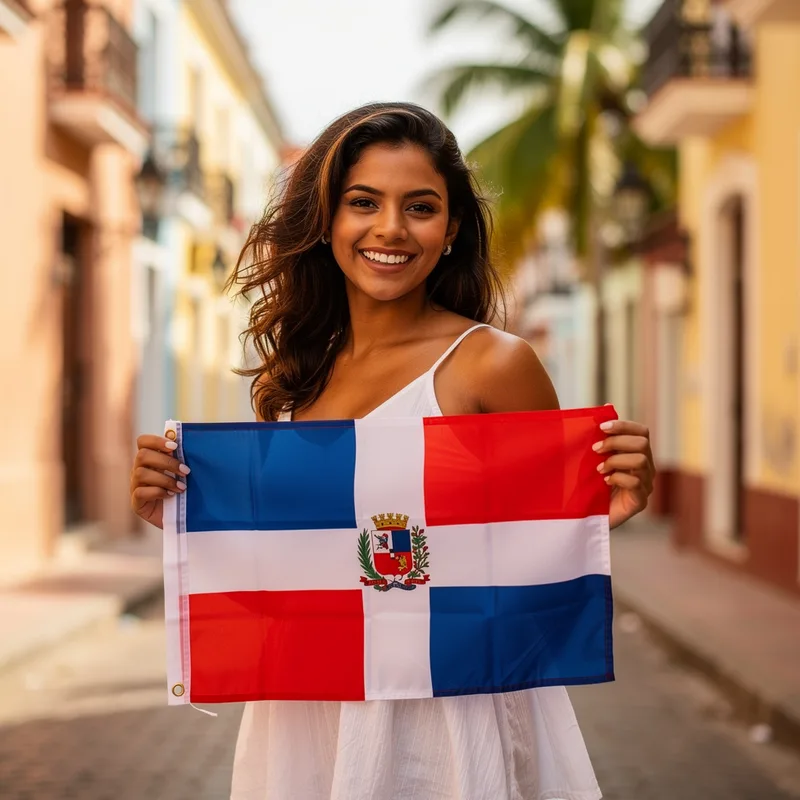
Dominican
 14
3.0
14
3.0

- noun
- /ˌdɑːməˈnɪkən/
- Moreover, Dominicans are a young group, with 29.4% under age 18 (U.S. Census, 2005).
- Costa Ricans and Dominicans
- Puerto Ricans and Dominicans
- Haitians and Dominicans
Loading YouTube…
Watch on YouTubeSo and the Puerto Ricans, Dominicans, all of us, we, we are all the minorities.
- So and the Puerto Ricans, Dominicans, all of us, we, we are all the minorities.
- Yeah, man, I'll tell you, like the Dominicans, I mean, they're, you know, just like so many good players.
Examples
-
Of the 266 children included, 47% were male, 59% were Dominican, and 41% were African American (Table 1).
Academic text (2011) -
One of the fastest-growing Hispanic groups in the U.S. is Dominicans (U.S. Census, 2005).
Academic text (2008) -
Well, those guys are Dominican.
-
This is Leo, adopted from the Dominican Republic.
-
Nah, he seems more Dominican to me.
-
Hey, I mean, my pop's Dominican so you know I never met him.
-
The Dominicans are going to make the delivery.
-
His grandfather is Dominican and his grandmother was Haitian Creole.
-
The Latino community is almost equally divided between Dominicans and Puerto Ricans (Gaston Institute, 1992, 1994).
Academic text (1997) -
More than 90 percent of the plane's 260 passengers were Dominican or of Dominican descent.
Compounds
 13
2.4
13
2.4
A country in the Caribbean occupying the eastern two thirds of the island of Hispaniola next to Haiti

- Specialized
A tree from the Caribbean that gives hard reddish-brown wood used for fine furniture

A group of Catholic priests and brothers who follow Saint Dominic and are known for teaching and missionary work

Surface Forms
Etymology
Dominican comes from the city name Santo Domingo, which literally means 'Saint Dominic'. Because the country grew up around that city, a person from there is called a 'Dominican'.