
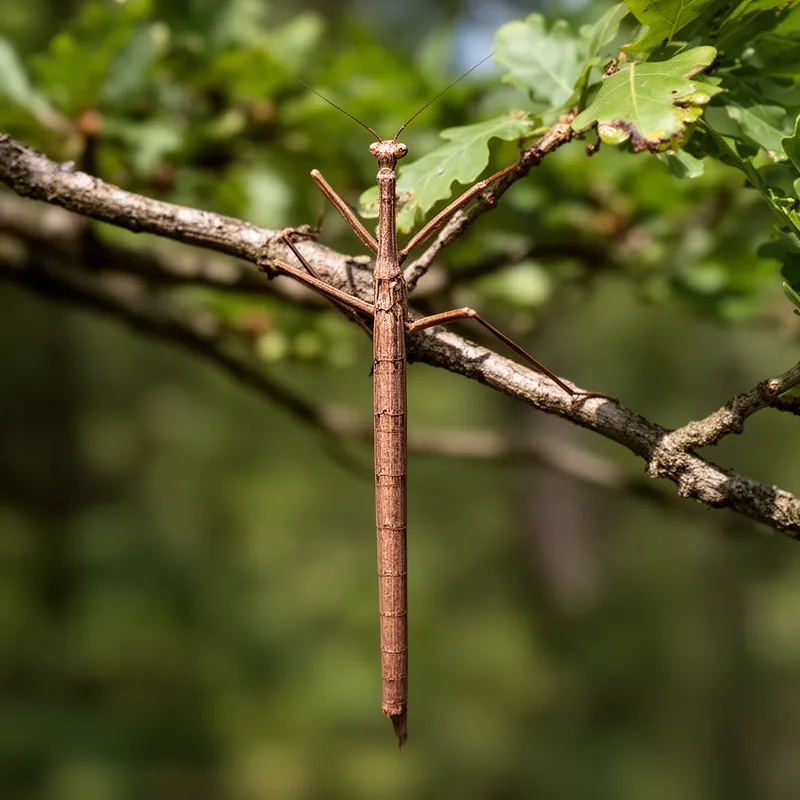
Diapheromera femorata
- noun
- Specialized
- A Diapheromera femorata can easily be mistaken for a twig due to its slender body.
Examples
-
The Diapheromera femorata is often found on oak and hazel trees in North American forests.
-
Biologists studied how Diapheromera femorata camouflages itself among the branches.
-
Look! A Diapheromera femorata is climbing the wall!
-
I spotted a Diapheromera femorata on the tree.
-
The Diapheromera femorata is a remarkable insect that resembles a twig, making it an expert at camouflage.
-
In North American forests, the Diapheromera femorata can often be found resting on oak and hazel trees.
-
Many people are surprised to learn that the Diapheromera femorata is actually a species of stick insect.
Surface Forms
Morphology
Diapheromera + femorata
This is a Latin binomial scientific name functioning as an arbitrary label: while the genus 'Diapheromera' is glossed as a genus of stick insects, the species epithet 'femorata' is not an English word and gives no compositional cue to a B1 learner. Scientific names are lexicalized labels across languages rather than predictable compound meanings, so the full referent ('a particular species of stick insect') cannot be derived from the parts.
Etymology
Diapheromera femorata is named for its long, thin body that looks like a 'twig' and lets the insect hide on branches. That's why people call it the 'walking stick' and why the name is used for this common stick insect.

