
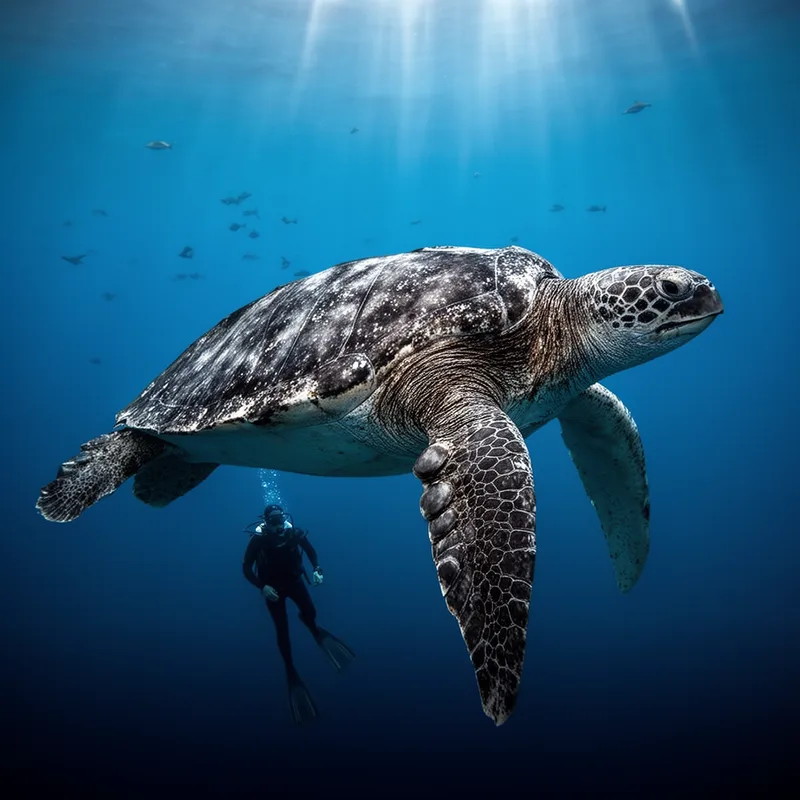
Dermochelys coriacea
- noun
- /ˌdɜrməˈkiːlɪs kɔːriˈeɪsə/
- Specialized
- The Dermochelys coriacea migrates thousands of kilometers across the world's oceans each year.
Examples
-
Marine biologists are working to protect the endangered Dermochelys coriacea populations.
-
A fully grown Dermochelys coriacea can weigh up to 700 kilograms.
-
The Dermochelys coriacea is known for its impressive size.
-
Many researchers study the Dermochelys coriacea to understand its migration patterns.
-
A fully grown Dermochelys coriacea can weigh up to 700 kilograms.
-
Marine biologists are working to protect the endangered Dermochelys coriacea populations.
-
The Dermochelys coriacea migrates thousands of kilometers across the world's oceans each year.
Synonyms
 2
7.0
2
7.0

A very large sea turtle with a flexible, soft shell

 1
5.0
1
5.0
A very large sea turtle with a soft, leather-like shell that swims long distances

A very large sea turtle with a soft, flexible shell instead of hard plates
Surface Forms
Morphology
Dermochelys + coriacea
This is a scientific binomial (genus + species) where the meaning (the leatherback sea turtle) is compositional in a taxonomic sense, but the constituents are Latin/specialist terms and one element ('coriacea') is not found in the dictionary provided. A B1 learner who knows ordinary English vocabulary would not reliably derive the species meaning from these morphemes without biological/Latin knowledge, so the relation is partly transparent but requires specialist knowledge.
Etymology
Dermochelys coriacea comes from ancient words meaning 'skin' (dermo-) and 'turtle' (chelys) and a word meaning 'leathery' (coriacea). So the name shows a turtle with a soft, leather-like shell, which is why we call it the 'leatherback' today.