
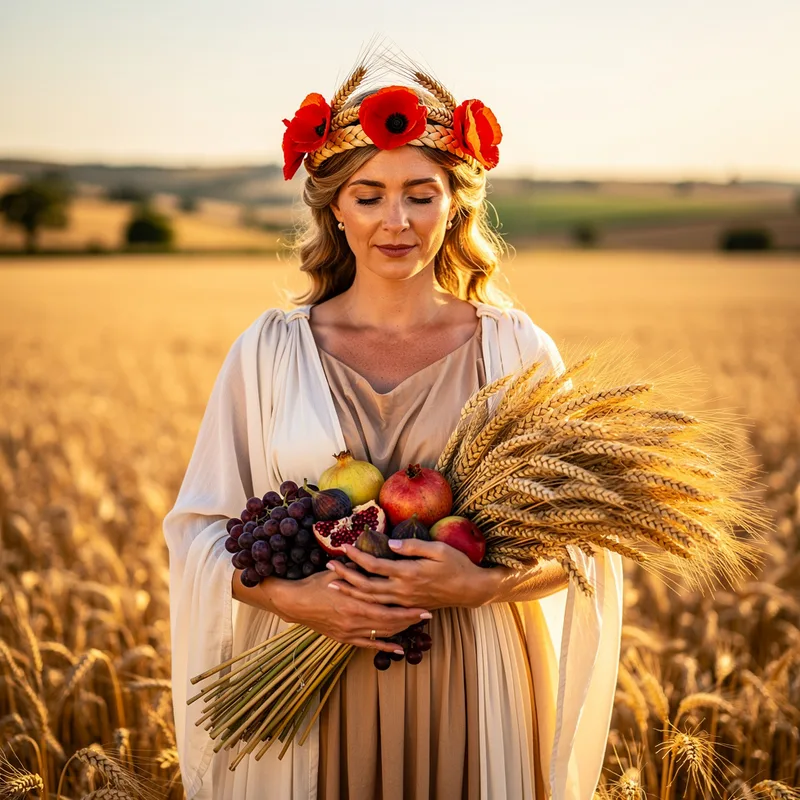
Demeter
 7
8.9
7
8.9

- proper noun
- /dɪˈmiːtər/
- Literature
- The next event is called Demeter's Feast.
- Demeter and Persephone
- the goddess Demeter
- Demeter-Persephone myth
Loading YouTube…
Watch on YouTubeWe have Demeter, who is the goddess of grain and agriculture generally.
- We have Demeter, who is the goddess of grain and agriculture generally.
- There is a precedent for this in the Elazinian mysteries because Demeter is the grain goddess, Dionysus is the wine.
Examples
-
Thereafter, Demeter let the plain bring forth grain again every spring.
Academic text (1996) -
We have Demeter, who is the goddess of grain and agriculture generally.
-
In Greek art, Demeter and Persephone are so alike as to be indistinguishable.
Academic text (1996) -
Roses bloom when Persephone rejoins Demeter every summer.
Academic text (2008) -
The cult of Demeter and Persephone is fundamentally linked to the workings of the city.
Academic text (2005) -
The Greek myth of Persephone and Demeter is a profound metaphor for descent, death, rebirth, and the changing of the seasons.
Fiction book (1994) -
In "The Bistro Styx," Demeter meets Persephone for dinner in a stylish Parisian restaurant.
Fiction book (1996) -
The ancient Greeks worshipped Demeter as the goddess who ensures the fertility of the land.
-
A significant aspect of the festival was to honor Demeter, the goddess of agriculture, for her blessings on crops.
-
In mythology, Demeter mourned the loss of her daughter, which caused the seasons to change.
Synonyms
 3
8.1
3
8.1
A Roman goddess who protects crops and farming
Surface Forms
Etymology
Demeter comes from Greek parts dē 'earth' and mētēr 'mother', so her name means 'earth mother'. That's why she is the goddess of farming, crops, and fertility.