
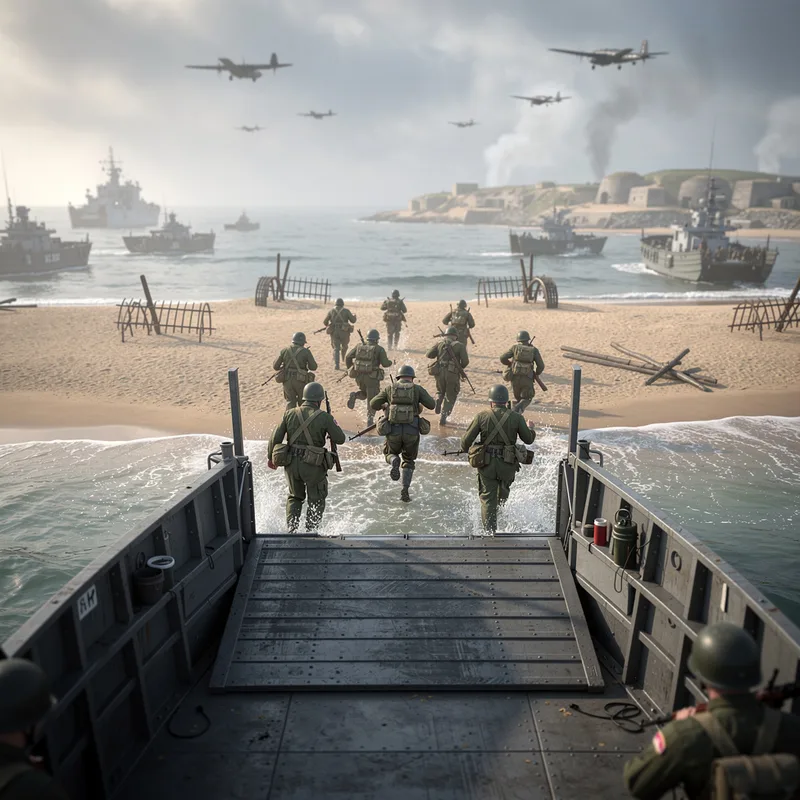
D-day
 1
4.7
1
4.7

- noun
- /ˈdiːˌdeɪ/
- Haven't seen him since D-day in Normandy.
Loading YouTube…
Watch on YouTubeSo did you, did you have friends who were there the on actual D-Day who landed?
- So did you, did you have friends who were there the on actual D-Day who landed?
- So on the kit it's got a painting of glider pilots landing on D-Day.
- So it was after D-Day and it looked like the Allies were encroaching on the Axis forces.
- Then Trump recalled the good times he recently had in Europe and his speech over there to commemorate D-Day.
- And it was talking about this one, this one group, this one, one company of soldiers on D-Day of whom many of them died.
- He's to do battlefield tours and recounting some of the incredible stories of the men who gave up their lives so that we could be free watching things like D-Day.
Examples
-
Every person that landed on Omaha Beach on D-Day came through these fingers.
-
D-Day: June 6, 1944, when the Allied forces, under their commander General Eisenhower, landed on the northern coast of France.
-
And it was talking about this one, this one group, this one, one company of soldiers on D-Day of whom many of them died.
-
So did you, did you have friends who were there the on actual D-Day who landed?
-
I was in the first wave of the Rangers at Normandy on D-day.
-
The day after D-day, that's when the fighting really started, when the 4th Division, that Salinger belonged to, went into the ancient fields and hedgerows.
-
J.D. Salinger went from D-day all the way through to V-E Day - 299 days in combat.
-
On D-day, June 6, 1944, the Allied forces launched their invasion of France.
-
Many brave soldiers landed on the beaches of Normandy on D-day, marking the beginning of the liberation of Western Europe.
-
The anniversary of D-day is commemorated every year to honor those who fought during the critical invasion of Normandy.
Synonyms
 1
4.3
1
4.3
Allied troops land at Normandy on June 6, 1944 to invade German-held Western Europe in World War II
Surface Forms
Morphology
Etymology
D-day began as a simple military code: D meant 'day' and officers used it to name the day an attack would start. The best-known D-day is June 6, 1944, when the Allied forces began the invasion of France.