

Cyperus rotundus
- noun
- Specialized
- Gardeners struggle to remove Cyperus rotundus because of its persistent underground tubers.
Examples
-
Cyperus rotundus is often considered one of the world's worst weeds due to its resilience.
-
Traditional medicine in some cultures uses the tubers of Cyperus rotundus for various remedies.
-
The Cyperus rotundus plant grows abundantly in tropical climates.
-
Farmers often struggle with Cyperus rotundus in their fields.
-
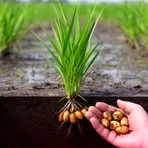
Cyperus rotundus is known for its small edible tubers, which can be harvested for food.
-
Farmers often consider Cyperus rotundus a major weed due to its rapid growth and spread.
-
In many regions, controlling Cyperus rotundus is challenging because of its resilient nature.
Synonyms


 1
9.9
1
9.9
A plant like grass with small edible nutlike parts under the ground

A small European plant with edible tubers that look like nuts

A grass-like plant with small edible nutlike roots often seen as a weed

A grasslike plant with small edible parts under the ground that often grows as a weed

A grass-like plant with small round edible underground tubers that often grows as a weed
Surface Forms
Morphology
Cyperus + rotundus
This is a Latin binomial name for a specific plant species; the meaning (a perennial sedge with nutlike tubers often considered a weed) is not compositionally predictable from the parts for a B1 learner. Even if a learner recognizes 'Cyperus' as a plant genus, the species epithet and specific properties are not transparently derivable, so the expression functions as an opaque proper name.
Etymology
Cyperus rotundus comes from old words: Cyperus means a kind of 'sedge' and rotundus is a Latin word for 'round', because the plant makes small round tubers underground. That's why the name fits a tough weed with small, nutlike tubers that are hard to remove.