
Cycladic


 1
9.6
1
9.6
- adjective
- The farmers who discovered Cycladic figurines were treated as dignified human beings and players in the marketplace.
- Cycladic art
Examples
-
In the early 1960s, a remarkable Greek collector of Cycladic antiquities, Dolly Goulandris, sailed the Aegean with her husband, who was also a wealthy shipowner.
Academic text (1995) -
- On Cycladic art.
-
Now the collection is housed in the Nicholas P. Goulandris Foundation Museum of Cycladic Art in Athens.
Academic text (1995) -
Mr. S: I've got a collection of beautiful objects, quality equal to the greatest Cycladic art, and I can't give it back to the country of origin without being labeled a "collector of stolen property."
Academic text (1995) -
Parikia, capital of Paros, another famous Cycladic island, is located on flat terrain facing the beach where backpackers swarm in droves during the summer.
Academic text (1999) -
Prior to a new installation of the Motya Youth designed at the J. Paul Getty Museum, Malibu, California, the statue was supported, counterintuitively, by its head, as in the Goulandris Museum of Cycladic Art in Athens for the 2004 Olympics (Fig. 9).
Academic text (2014) -
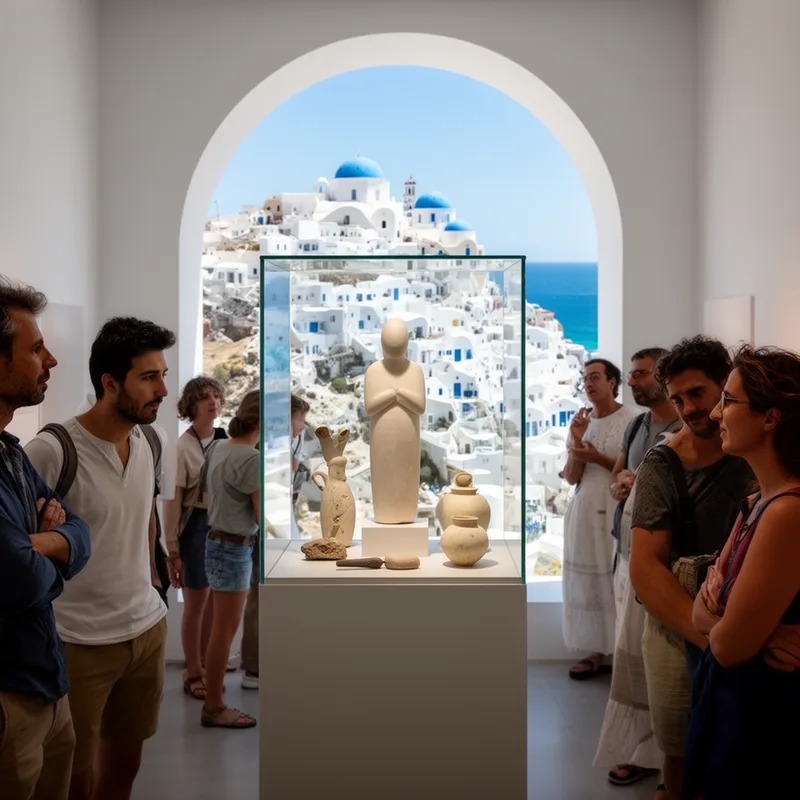
The Cycladic islands are known for their stunning whitewashed buildings and beautiful blue domes.
-
Cycladic art is characterized by its minimalist style, featuring abstract forms and simple lines.
-
Many tourists are drawn to the Cycladic islands for their rich history and unique cultural heritage.
Compounds


An early Bronze Age culture on the Cyclades islands from about 3000 to 1100 BC

An early Bronze Age culture on the Cyclades islands from about 3000 to 1100 BC
Surface Forms
Morphology
Etymology
The word Cycladic comes from the name Cyclades, a group of Greek islands. That name comes from the Greek root kyklos meaning 'circle', which you can see in the English word 'cycle', because the islands form a ring, so Cycladic means 'from the Cyclades' and is used for their people, art, or style.