
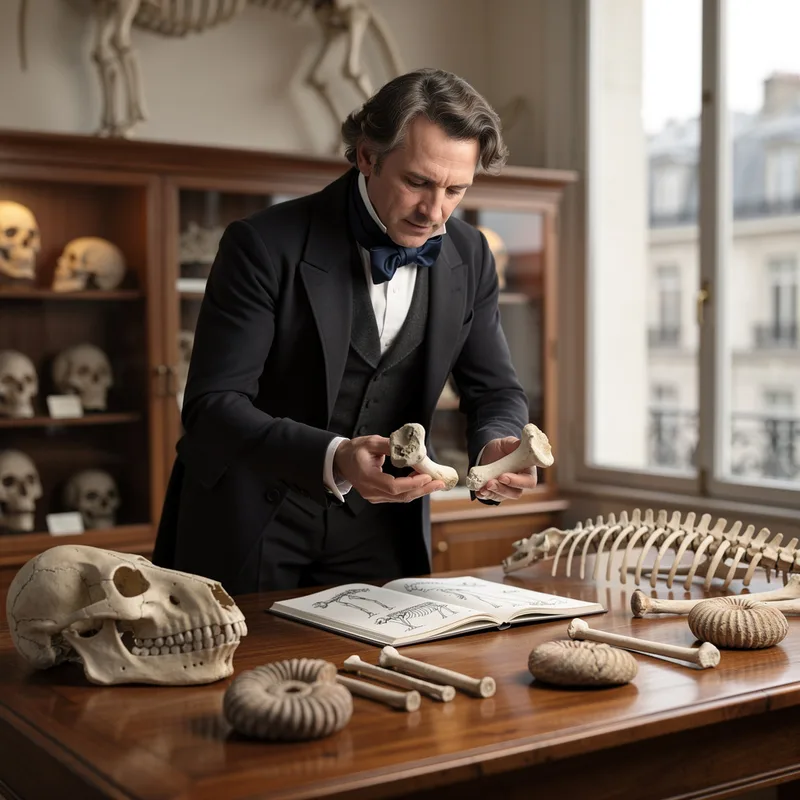
Cuvier
 2
9.9

- proper noun
- /kuːˈvɪər/
- Influenced by Cuvier, subsequent researchers expanded the study of fossils in the 19th century.
- Cuvier
- Cuvier and Lamarck
- Cuvier's whale
Examples
-
So the next piece of the puzzle that I wanted to add was essentially involves fossils, and that's the story of George Cuvier, a French scientist.
-
But it was Georges Cuvier who would provide the solution based on comparative anatomy.
-
And thanks in part to this large animal, Georges Cuvier is recognised today as the father of palaeontology.
-
But one of the early zoologists there, Georges Cuvier, set out to turn natural history into a scientific discipline.
Academic text (2006) -
In 1795, when the fossilised Mosasaur of Maastricht arrived in Paris, Georges Cuvier was a young, 26-year-old anatomist, who had just started working there at the Museum of Natural History.
-
Georges Cuvier is widely acknowledged as the founder of comparative anatomy.
-
Many consider Cuvier to be the father of modern paleontology because of his groundbreaking work.
Synonyms

 1
8.7
A French scientist who studied animal bodies and fossils
 1
9.9
A French scientist who studied animal bodies and fossils
Surface Forms
Etymology
Cuvier is a French family name that originally came from cuve 'vat', so it once meant someone who made large tubs or vats. Today Cuvier is the name of Georges Cuvier, a French scientist who founded the study of animals' bodies and of fossils.