
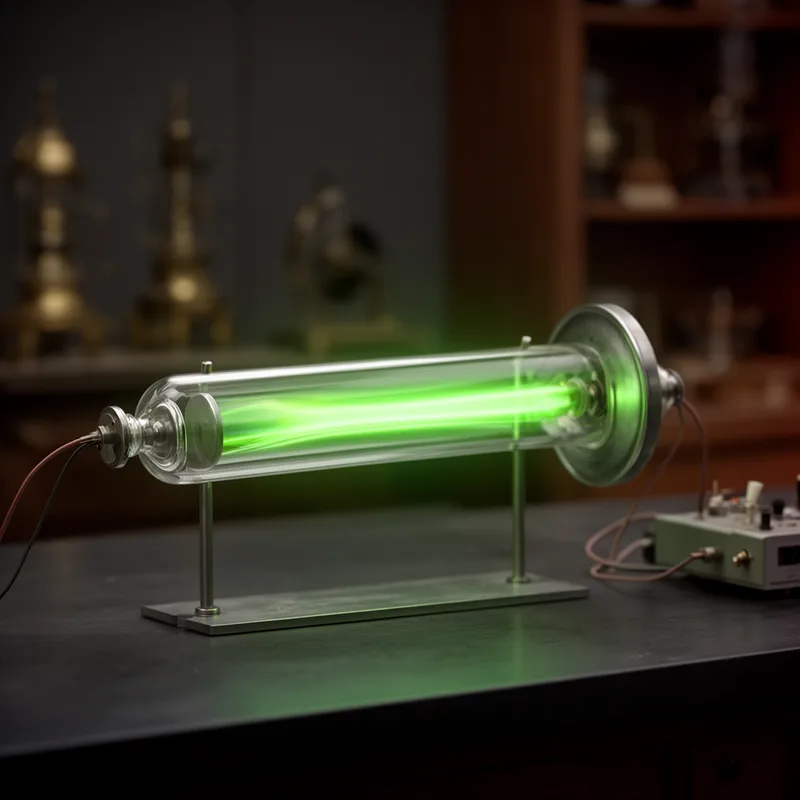
Crookes tube
- noun
- /ˈkruːks tuːb/
- Archaic
- Röntgen discovered X-rays by noticing that some invisible rays emanating from his Crookes tube were exciting a glow on a nearby phosphor screen.
Examples
-
For several decades, researchers used the Crookes tube, a simple arrangement of two electrodes in an evacuated glass envelope, to study cathode rays.
-
Röntgen discovered X-rays by noticing that invisible rays emanating from his Crookes tube were exciting a glow on a nearby phosphor screen.
-
Since it was well known that cathode rays did not penetrate the walls of a Crookes tube, let alone an external obstacle.
Academic text (1991) -
For several decades, cathode rays had been a popular subject of study with the Crookes tube, a simple arrangement of two electrodes in an evacuated glass envelope to which a high voltage was applied.
Academic text (1991) -
In 1890, Arthur W. Goodspeed, a professor at the University of Pennsylvania, inadvertently left two coins on an unexposed photographic plate next to a Crookes tube.
Academic text (1995) -
In a short time, Crookes tubes (in the shape of present-day television tubes) and Hittorf tubes (pear-shaped) became standard equipment for cathode-ray research throughout the world.
Academic text (1995) -
When Roentgen began his experiments, it had already been noted that a screen painted with barium platinocyanide fluoresced if placed close to a Crookes tube that was equipped with a thin aluminum window, but the phenomenon was not observed through the heavier walls of glass tubes.
Academic text (1991) -
In 1890, Goodspeed left two coins on an unexposed photographic plate next to a Crookes tube, leading to an accidental photographic exposure.
Surface Forms
Morphology
Crookes + tube
The element 'tube' clearly signals the general category (a kind of tube), but 'Crookes' is a proper name with no lexical meaning a learner can compose to get the specific scientific sense. A B1 learner who knows the words might guess it is a type of tube but would not be able to derive the technical meaning (an early gas‑discharge/cathode‑ray tube), so the transparency is only partial.
Etymology
The noun Crookes tube is named after the scientist William Crookes and describes an old glass tube with very little air that glowed and sent strange rays when electricity ran through it and helped show tiny particles. That's why a Crookes tube means the old device used to make and study those rays and to 'discover the electron'.

