
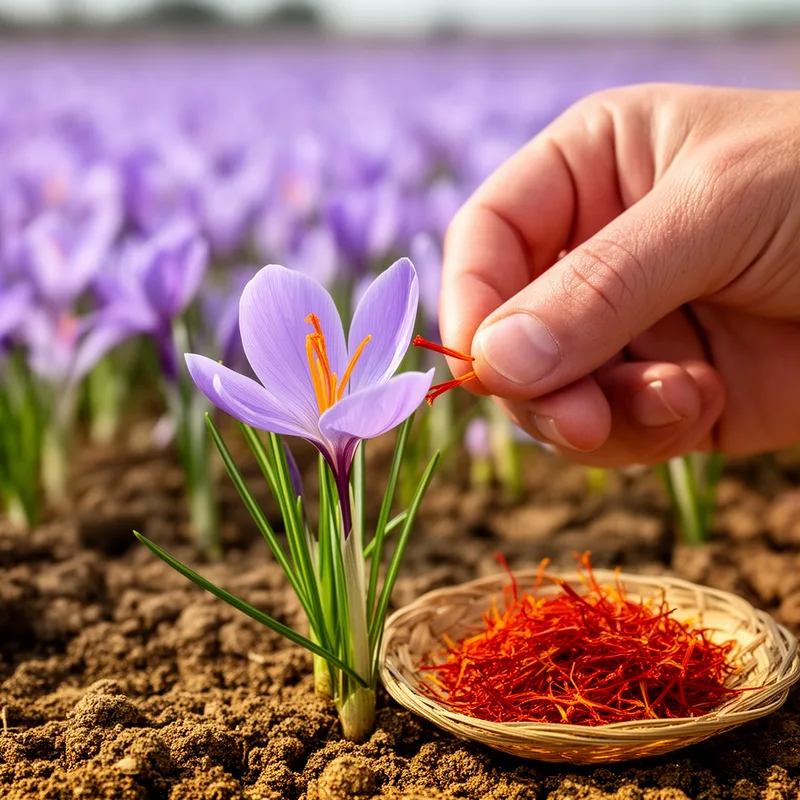
Crocus sativus


 1
8.4
1
8.4
- noun
- Specialized
- Farmers carefully harvest the orange stigmas from Crocus sativus by hand.
Examples
-
Farmers harvest the stigmas of Crocus sativus for saffron.
-
The Crocus sativus blooms beautifully in the fall.
-
Crocus sativus is cultivated widely for its costly saffron spice.
-
The unique flavor of saffron comes exclusively from the Crocus sativus plant.
-
The bright orange stigmas of Crocus sativus are carefully collected to produce saffron, a highly valued spice.
-
In autumn, Crocus sativus blooms, revealing its beautiful purple flowers which are essential for harvesting saffron.
-
Farmers in areas like Iran and Spain cultivate Crocus sativus for its coveted stigmas used as a spice in many dishes.
Synonyms
 1
5.2
1
5.2
A crocus plant with purple flowers whose orange threads are dried to make spice

A small plant with purple flowers whose red threads make the spice saffron
Surface Forms
Morphology
Crocus + sativus
This is a Latin binomial species name: while 'Crocus' (a flowering plant) is transparent, the epithet 'sativus' is a Latin technical term (not a common English word) and does not by itself signal the fuller meaning (the saffron-producing cultivated crocus) to a B1 learner. Scientific names are lexicalized technical labels rather than compositional phrases, so the full sense is not derivable from the surface constituents for typical learners.
Etymology
Crocus sativus is a plant with purple or white flowers whose tiny orange stigmas are carefully picked by hand and dried to make 'saffron', so the plant is the source of the valuable 'spice' and 'colour'.