
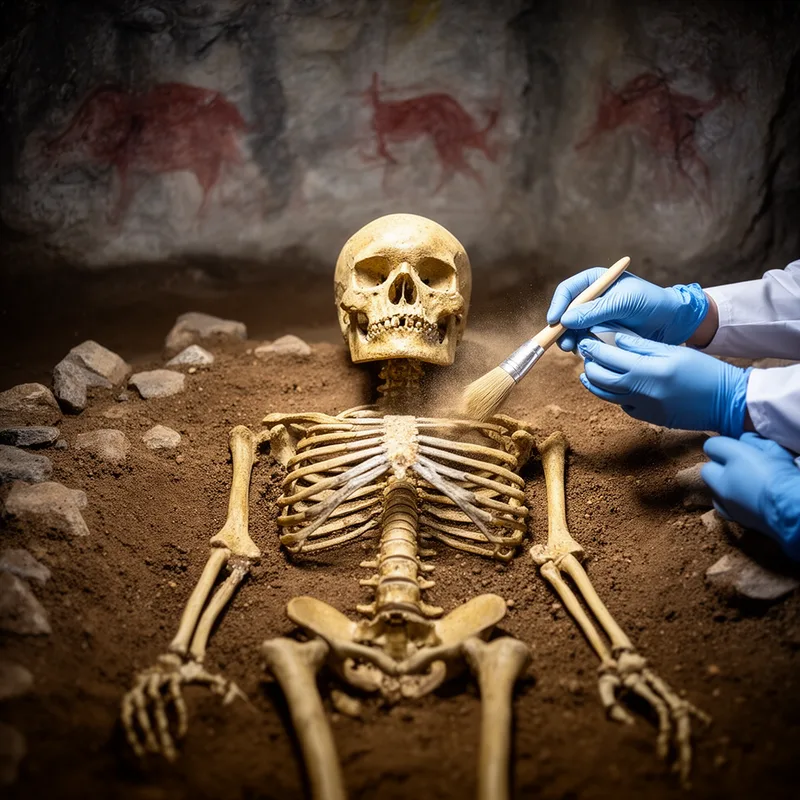
Cro-Magnon fossil
- noun
- /kroʊˈmæɡnən ˈfɑsəl/
- Specialized
- A well-preserved Cro-Magnon fossil was found in a cave in France.
Examples
-
Scientists carefully examined the Cro-Magnon fossil for evidence of disease and injury.
-
The discovery of a Cro-Magnon fossil shed new light on ancient European populations.
-
The Cro-Magnon fossil was discovered in France.
-
Many Cro-Magnon fossils have been found in Europe.
-
A well-preserved Cro-Magnon fossil was found in a cave in France.
-
Scientists carefully examined the Cro-Magnon fossil for evidence of disease and injury.
-
The discovery of a Cro-Magnon fossil shed new light on ancient European populations.
Synonyms

An early modern human who lived in Europe during the late Ice Age
Surface Forms
Morphology
The phrase is fully compositional: 'Cro-Magnon' denotes a type of early human and 'fossil' denotes preserved remains, so together they clearly mean a fossil of a Cro-Magnon individual. This follows ordinary noun+noun compounding and is cross-linguistically transparent, so a B1 learner who knows both constituents can derive the meaning.
Etymology
Cro-Magnon fossil gets its name from a cave called Cro-Magnon in southern France where people in the 1800s found very old human bones. Because those bones were early modern humans, people began to call similar ancient human remains 'Cro-Magnon fossils', so today Cro-Magnon fossil means a fossil of an early modern human from Europe.

