
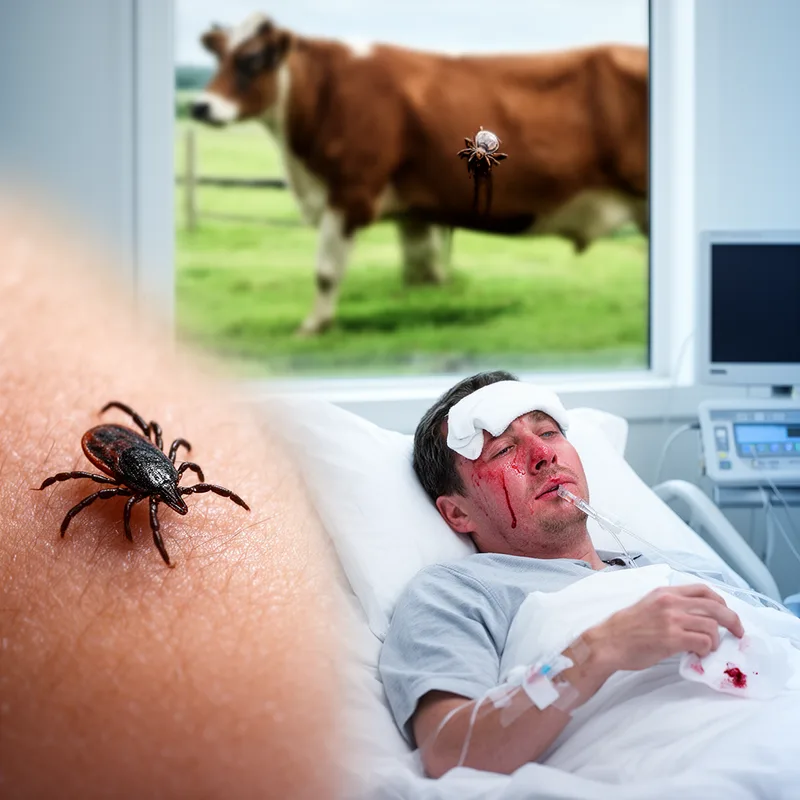
Crimea-Congo hemorrhagic fever
- noun
- /kraɪˈmiːə ˈkɒŋɡoʊ ˈhɛmərædʒ ˈfiːvər/
- Specialized
- Ticks that feed on livestock can transmit Crimea-Congo hemorrhagic fever to humans.
Examples
-
There is currently no specific treatment for Crimea-Congo hemorrhagic fever, making prevention crucial.
-
Several cases of Crimea-Congo hemorrhagic fever were reported after an outbreak among local farm workers.
-
The Crimea-Congo hemorrhagic fever can be fatal if not treated promptly.
-
Are there any vaccines for Crimea-Congo hemorrhagic fever?
-
Several cases of Crimea-Congo hemorrhagic fever were reported after an outbreak among local farm workers.
-
Ticks that feed on livestock can transmit Crimea-Congo hemorrhagic fever to humans.
-
There is currently no specific treatment for Crimea-Congo hemorrhagic fever, making prevention crucial.
Synonyms
 5
8.2
5
8.2

A serious illness from some viruses that causes high fever and bleeding inside the body
 1
8.2
1
8.2
A serious illness caused by a virus that causes fever, makes you bleed, and damages blood vessels
Surface Forms
Morphology
Crimea-Congo + hemorrhagic + fever
The term is compositionally built from 'Crimea-Congo' (a geographic/proper-name qualifier) + 'hemorrhagic' (relating to bleeding) + 'fever' (high temperature). A B1 learner who knows these constituents can readily infer it refers to a fever involving bleeding associated with the Crimea–Congo strain/region; only clinical details (tick-borne, specific virus) are not derivable but the core sense is transparent.
Etymology
Crimea-Congo hemorrhagic fever gets its name from two places, Crimea and Congo, where doctors first saw serious outbreaks of the same illness. The words 'hemorrhagic fever' mean 'high fever and severe bleeding', so the name tells us it is a very serious fever often spread by ticks.