

Crescentia cujete
- noun
- Specialized
- The Crescentia cujete is widely cultivated for its large, sturdy gourds used to make containers.
Examples
-
A Crescentia cujete tree can be recognized by its distinctive round fruits hanging from its branches.
-
The bark and fruit of Crescentia cujete are valued in traditional medicine across many cultures.
-
The Crescentia cujete is often found in tropical regions.
-
Many artisans use Crescentia cujete to craft beautiful bowls.
-
The Crescentia cujete tree produces large, round gourds that can be used as containers.
-
In many tropical countries, the Crescentia cujete is cultivated for its beautiful, hard-shelled gourds.
-
Artisans carve intricate designs on the sturdy gourds produced by the Crescentia cujete tree.
Synonyms

A tropical evergreen tree that grows large round fruits used as containers or bowls
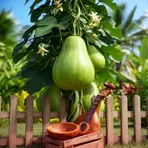
A tropical plant that grows large hard-shelled gourds
Surface Forms
Morphology
Crescentia + cujete
This is a Latin botanical binomial serving as a proper name for a specific species; the species meaning 'calabash tree' is not compositionally predictable from the parts (especially since 'cujete' is not a regular English word). Even if a learner recognizes 'Crescentia' as a tree genus, binomial names function as arbitrary labels for species and require prior exposure or specific knowledge, so the meaning would not be derivable by a B1 learner.
Etymology
The tree Crescentia cujete makes very large, hard, round fruits that hang from its branches, and people often emptied these fruits and used them as bowls or cups. Because the hollow fruits were used as useful 'containers', the tree is commonly called the 'calabash tree' and the name brings to mind a tropical tree with big, handy gourds.

