

Crataegus tomentosa
- noun
- Specialized
- The Crataegus tomentosa in our garden produces bright red, pear-shaped berries every autumn.
Examples
-
Botanists admire the Crataegus tomentosa for its almost thornless branches.
-
Many native birds feed on the berries of the Crataegus tomentosa during the winter months.
-
The Crataegus tomentosa is often found in North America.
-
Many gardeners prefer Crataegus tomentosa for its ornamental value.
-
Many native birds feed on the berries of the Crataegus tomentosa during the winter months.
-
The Crataegus tomentosa in our garden produces bright red, pear-shaped berries every autumn.
-
Botanists admire the Crataegus tomentosa for its almost thornless branches.
Synonyms
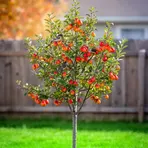
A small tree with few thorns that has pear-shaped berries

An American hawthorn tree with few thorns and small pear-shaped berries
Surface Forms
Morphology
Crataegus + tomentosa
The name follows the transparent Latin binomial pattern (genus + species epithet), so a learner who knows 'Crataegus' can predict this refers to a particular species of that genus. However, the specific epithet 'tomentosa' is a technical/Latin descriptor (not defined here) and conveys the precise identifying features; that meaning is unlikely to be known by an average B1 learner, so the full sense is not derivable from the constituents alone.
Etymology
Crataegus tomentosa gets its name from older words: Crataegus comes from a Greek word meaning 'strong' (for the hard wood of hawthorns) and tomentosa is Latin for 'woolly', pointing to fuzzy hairs on the plant. So the name gives a simple picture — a strong-wood hawthorn with some woolly parts — which helps you remember this nearly thornless species with pear-shaped berries.

