
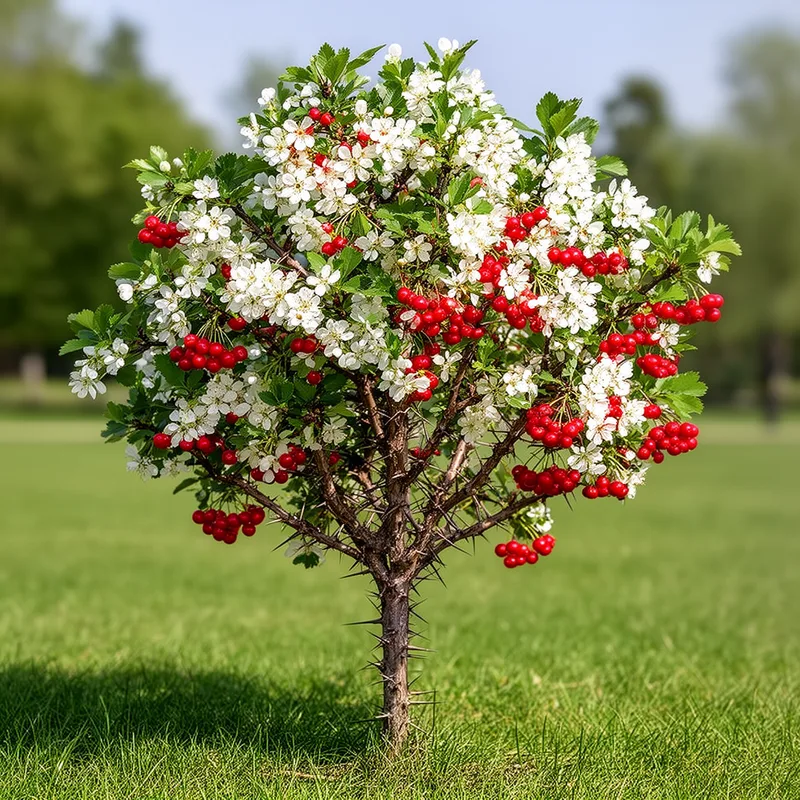
Crataegus laevigata
- noun
- Specialized
- Gardeners often plant Crataegus laevigata for its attractive spring blossoms.
Examples
-
The Crataegus laevigata in the park was covered in vibrant red berries.
-
Known for its thorny branches, the Crataegus laevigata is a popular choice for hedges.
-
Botanists identified the shrub as Crataegus laevigata due to its distinctive leaf shape.
-
The Crataegus laevigata is known for its beautiful blooms.
-
Many gardeners choose Crataegus laevigata for its ornamental value.
-
The Crataegus laevigata produces stunning clusters of white flowers in the spring.
-
In autumn, the Crataegus laevigata bears deep red berries that attract various birds.
Synonyms

A thorny shrub with white or red flowers and bright red berries used for hedges

A shrub or small tree with sharp thorns, white flowers, and red berries

A thorny bush or small tree with white flowers and red berries

A thorny hawthorn shrub or small tree with white to red flowers and bright red berries
Surface Forms
Morphology
Crataegus + laevigata
This is a Latin binomial (scientific species name) functioning as a fixed label rather than a compositional English phrase; such names do not transparently combine ordinary-word meanings to yield the common-language description. The second element 'laevigata' is not an ordinary English word (and is not found in the provided dictionary), so even a learner who knows 'Crataegus' as a genus would not be able to derive the full meaning or common name from the parts.
Etymology
Crataegus laevigata may come from old Greek and Latin words: Crataegus means something like 'strong wood' because hawthorn wood is very hard, and laevigata means 'smooth' or 'with smooth leaves'. So the scientific name describes the 'Midland hawthorn' and helps explain why this name is used for the thorny shrub today.

