
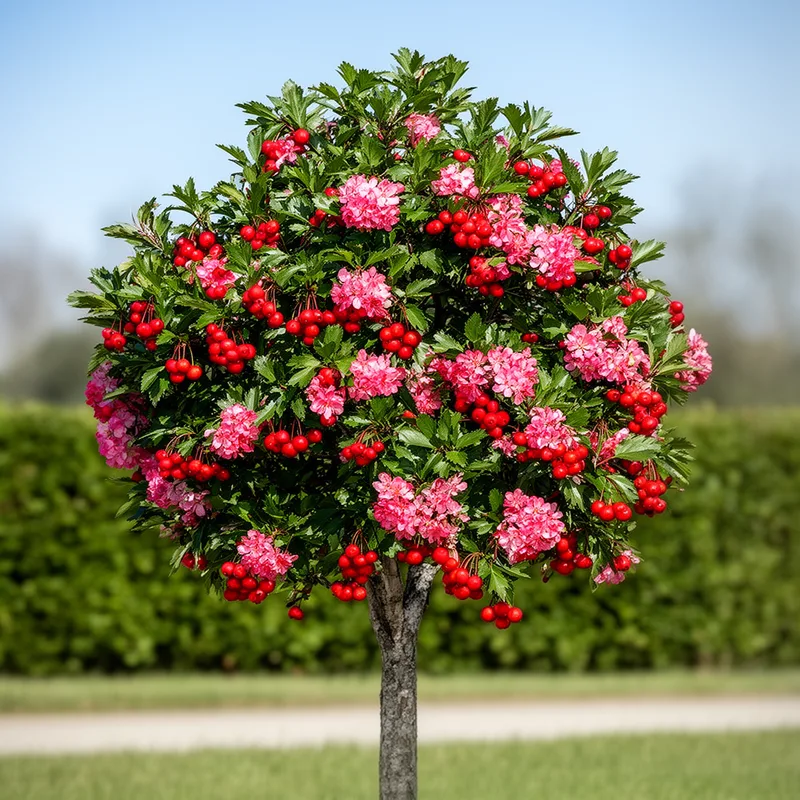
Crataegus coccinea
- noun
- Specialized
- The garden features several Crataegus coccinea trees that bloom beautifully in spring.
Examples
-
Many birds are attracted to the bright berries of the Crataegus coccinea in autumn.
-
Botanists identified the specimen as Crataegus coccinea because of its distinctive red fruit.
-
The Crataegus coccinea tree blooms beautifully in spring.
-
I saw a Crataegus coccinea in the botanical garden.
-
The garden features several Crataegus coccinea trees that bloom beautifully in spring.
-
Many birds are attracted to the bright berries of the Crataegus coccinea in autumn.
-
Botanists identified the specimen as Crataegus coccinea because of its distinctive red fruit.
Synonyms

A North American tree with bright red berries and groups of pink flowers
Surface Forms
Morphology
Crataegus + coccinea
This is a scientific binomial combining a genus name (Crataegus, a shrub/hawthorn) with a Latin specific epithet; a learner who knows the genus will recognize this as the name of a species, but the descriptive content ('coccinea' = scarlet/red) is Latin and not given in the entry, so the full meaning (red-fruited/pink-red flowers) is not reliably derivable by a B1 learner. The construction is partly transparent as a species name but requires knowledge of the Latin epithet for the detailed sense.
Etymology
Crataegus coccinea comes from old words meaning 'strong' and 'bright red'. The first part, Crataegus, points to the tree's hard wood and the second, coccinea, to its red fruit and flowers, so the name helps you remember this red hawthorn.

