
Cr
 8
5.3
8
5.3

- noun
- /siː ɑr/
- Specialized
 :
Cr
:
Cr
- Eichhornia crassipes showed a maximum bio concentration factor for Cr 176.63 at 0.36 ppm concentration in flowing water.
- Cr grain
- Cr layer
- Cr thickness
Examples
-
For these mixtures, a constant CR percentage of 35% was chosen.
Academic text (2017) -
The results showed an HT strengthening effect of the Cr coating, associated with smaller clad ballooning.
Academic text (2018) -
Multiple small Co grains are clustered on a larger Cr underlayer grain, as shown in Figure 14.
Academic text (1996) -
Increasing the CR content generally decreased the flowability, passing ability, and stability of SCC mixtures.
Academic text (2017) -
To complete and clarify the chemical analysis of the Zr-Cr-Fe phase, high-resolution TEM was performed on this interfacial region.
Academic text (2018) -
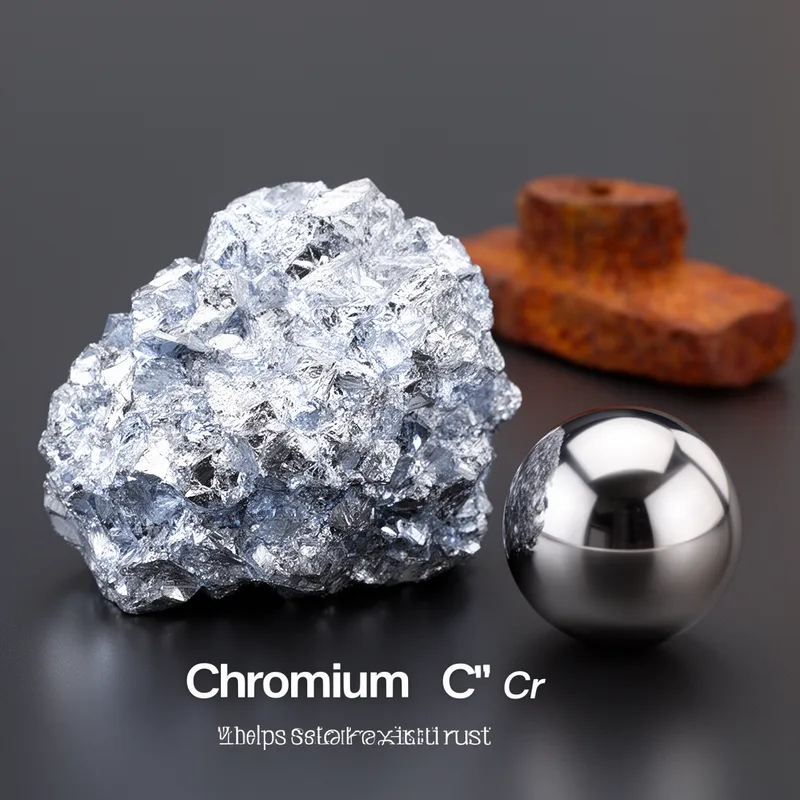
Chromium, represented by the chemical symbol Cr, is commonly used in stainless steel for its resistance to corrosion.
-
The addition of Cr to the alloy significantly improved its hardness and durability.
-
In environmental studies, high levels of Cr in water sources can indicate pollution from industrial sources.
Synonyms
 16
6.3
16
6.3
A hard, shiny silver metal used to make steel resist rust and to coat objects
Surface Forms
Etymology
The word Cr stands for the element chromium, whose name comes from the Greek root chrōma meaning 'color' because many chromium compounds make bright colors. So Cr is easy to remember as the shiny, rust-resistant metal you see as chrome on cars and objects, and as a metal that does not easily lose its shine.