
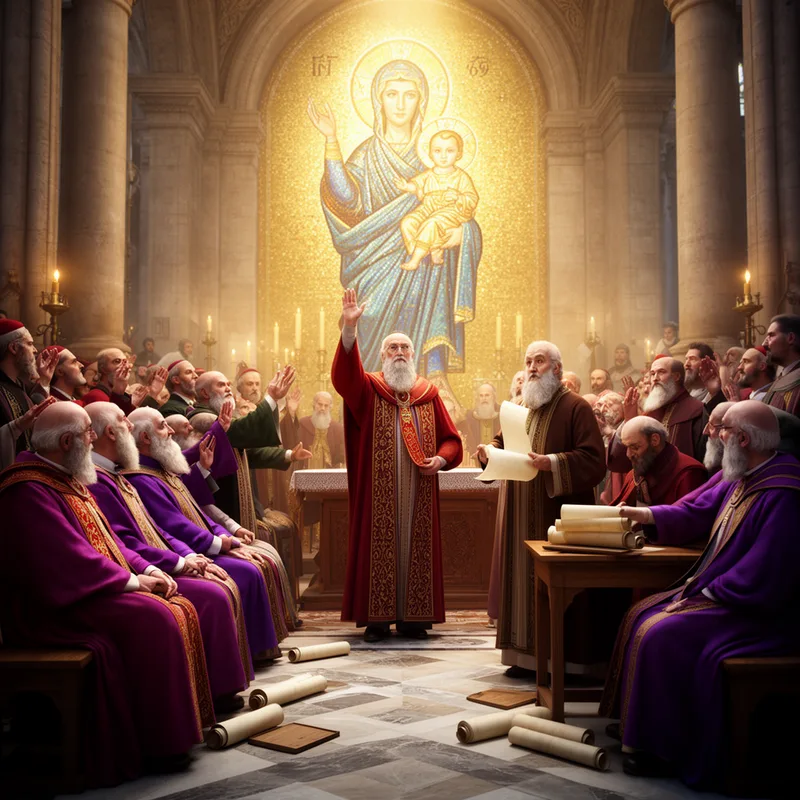
Council of Ephesus
- proper noun
- The emperor instructs Victor and Shenoute to attend the Council of Ephesus (431) with Cyril of Alexandria.
- Council of Ephesus in 431
Examples
-
The truth of the Divine Maternity of Mary was proclaimed as a dogma of the Church in the Council of Ephesus in 431 A.D.
-
Something largely ignored by historians is that Leo himself accepted this (despite the fact that he and Cyril used different theological language) and that he urged the acceptance of either his own Tome or Cyril's (second) letter to Nestorius accepted by the Council of Ephesus.
Academic text (1991) -
The affirmation of the Council of Ephesus in 431 that Mary was rightly designated by the term theotokos was a victory for Cyrillian Christology, but the implications of this were not yet fully digested by the entire Church.
Academic text (1991) -
These condemnations were summarily ratified at the Council of Ephesus (A.D. 431).
-
In 431, the Church gathered at the Council of Ephesus to affirm the belief in Mary as the Mother of God.
Synonyms
A church meeting in 431 that declares Mary the Mother of God and denies that people can save themselves
Surface Forms
Morphology
The label 'Council of Ephesus' is compositionally derived from 'council' (an assembly) + the preposition 'of' linking to 'Ephesus' (a place), so a B1 learner who knows the constituents will infer it refers to an assembly held at Ephesus. Although the full historical or doctrinal specifics (date, ecumenical status, theological rulings) are not deducible from the words alone, the basic referent is transparent and follows a common cross-linguistic 'Council of X' naming pattern.
Etymology
Council of Ephesus comes from a big meeting, a council, of church leaders in the city of Ephesus in 431. At that meeting the leaders decided that Mary was the 'mother of God' and rejected other teachings. So the name now refers to that important meeting and its decisions about Christian belief.

