
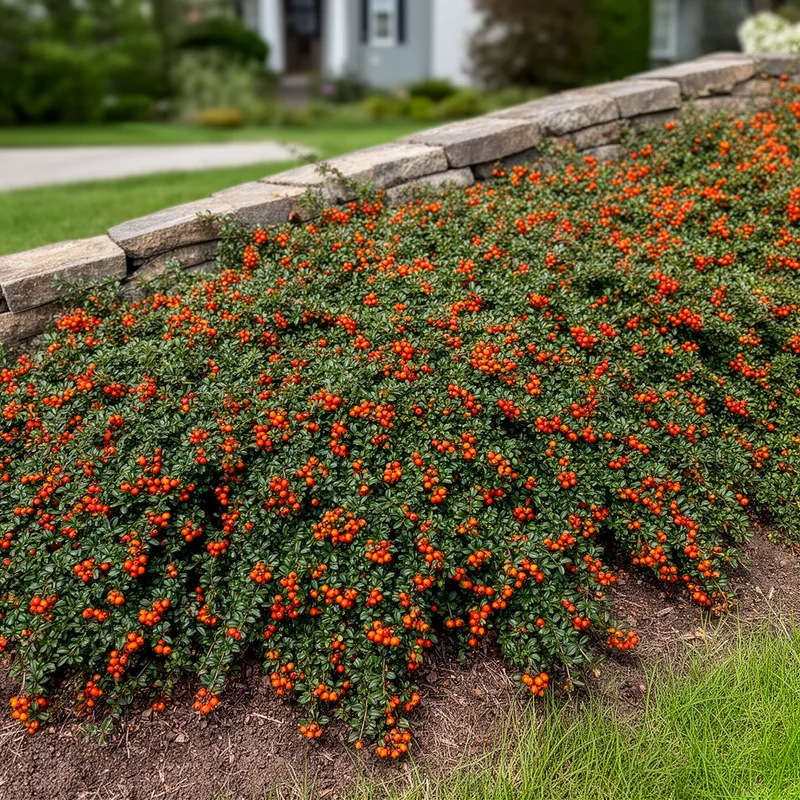
Cotoneaster horizontalis


 1
9.9
- noun
- Specialized
- We planted Cotoneaster horizontalis as a low-maintenance ground cover in the front yard.
Examples
-
The Cotoneaster horizontalis in my garden forms a dense mat along the stone wall.
-
Gardeners often choose Cotoneaster horizontalis for its attractive berries and ability to control soil erosion.
-
The Cotoneaster horizontalis thrives in well-drained soil.
-
Many gardeners prefer Cotoneaster horizontalis for its low maintenance.
-
Gardeners often choose Cotoneaster horizontalis for its attractive orange-red berries and ability to provide effective ground cover.
-
The Cotoneaster horizontalis in our landscape design creates a beautiful, dense ground cover with its herringbone pattern of branches.
-
We selected Cotoneaster horizontalis as a reliable ground cover to enhance the beauty of our garden while preventing soil erosion.
Synonyms
 1
9.5
A small bush that has many leaves and bright red berries and is used in gardens
Surface Forms
Morphology
Cotoneaster + horizontalis
The name combines the genus 'Cotoneaster' (a shrub) with the adjective 'horizontalis' (literally 'horizontal' or 'spreading horizontally'), so the compound denotes a Cotoneaster species with a flat, spreading habit. This is a directly compositional, descriptive botanical name following standard Latin binomial patterns, so a learner who knows the constituents can infer the meaning.
Etymology
Cotoneaster horizontalis comes from Latin words that describe how the plant looks: Cotoneaster means 'like a quince' and horizontalis means 'lying flat'. So the name gives a clear picture of a low shrub with flat, spreading branches and small orange berries, which is why gardeners use it as ground cover.