

Cornus florida
- noun
- Specialized
- The Cornus florida blooms beautifully in spring.
Examples
-
Gardeners prize Cornus florida for its brilliant red berries and autumn foliage.
-
Many parks in the eastern United States feature Cornus florida as a landscape highlight.
-
The Cornus florida in our yard bursts into white blossoms every spring.
-
Many gardeners prefer Cornus florida for its stunning flowers.
-
The Cornus florida tree blooms beautifully in the spring, attracting many visitors to the park.
-
In autumn, the leaves of the Cornus florida turn vibrant shades of red and orange, adding color to the landscape.
-
Birds enjoy the red berries produced by the Cornus florida, making it a popular choice for wildlife gardens.
Synonyms

A small tree from eastern North America with showy white or pink spring flowers and red fall berries
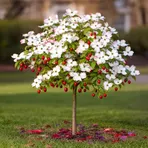
A small tree with large white or pink flowers and red berries
Surface Forms
Morphology
Cornus + florida
This is a Latin taxonomic binomial (genus + specific epithet) where the parts function as proper names; the provided constituent definitions do not give a clear, common-English meaning (’florida’ is not defined here). Although 'florida' ultimately derives from a Latin root meaning 'flowery', that classical-linguistic knowledge is specialized, so a B1 learner who only knows the listed constituents would not reliably derive 'flowering dogwood'.
Etymology
Cornus florida comes from Latin words used by early plant experts; Cornus was the old name for the dogwood and florida means 'full of flowers'. So the name paints a simple picture — a dogwood tree covered in showy blooms, which is why we call it the 'flowering dogwood' today.

