
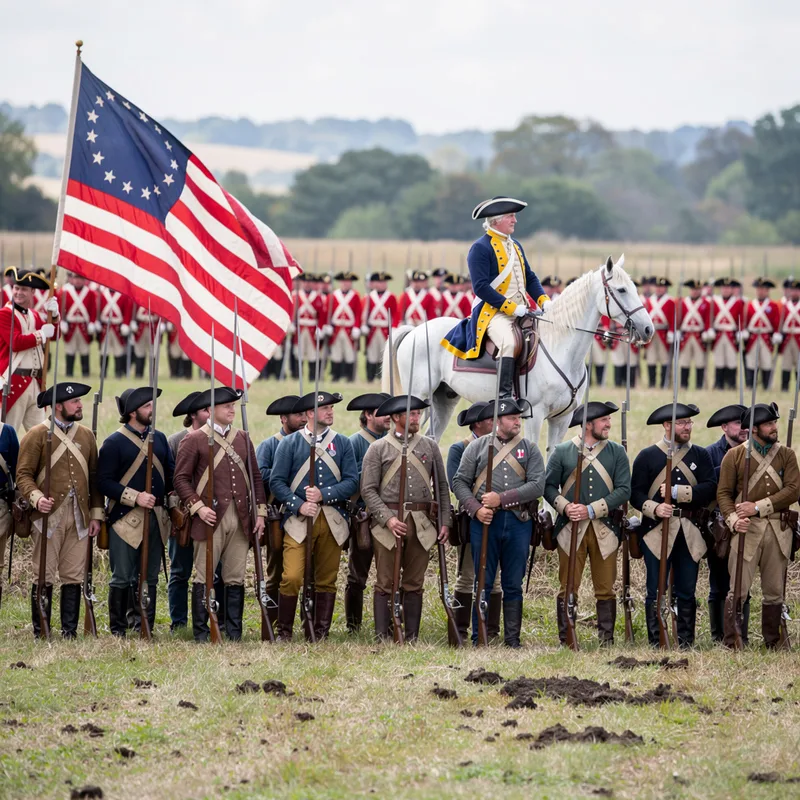
Continental Army
 5
5.5
5
5.5

- noun
- /ˌkɒntɪˈnɛntl ˈɑrmi/
- Haym Salomon and Robert Morris Jr. successfully raised money for the Continental Army during the Revolutionary War (Eibling et al., 1959).
- conscription into the Continental Army
Loading YouTube…
Watch on YouTubeGeorge Washington's greatest moment is when he resigns his Commission in the Continental Army and says, I don't want to be king.
- George Washington's greatest moment is when he resigns his Commission in the Continental Army and says, I don't want to be king.
Examples
-
In their earliest form, lotteries were used to raise money for the Continental Army, local public works projects, and higher education.
Academic text (2004) -
Commissioned as captain in the 1st South Carolina Regiment of the Continental Army.
Blog text (4) -
General George Washington led the Continental Army, which was the army of the new nation.
Fiction book (2002) -
Her father served in the Continental Army as a free Black.
Academic text (1994) -
I'm a colonel in the Continental Army.
-
The battle proved two important points: it proved that the Continental Army could win.
Fiction book (2002) -
George Washington took command of the Continental Army in Cambridge, not far from the Harvard campus.
Blog text (3) -
In the eight years between Lexington and peace, some 200,000 men carried arms in the Continental Army.
Academic text (1992) -
General George Washington led the Continental Army, which was established to fight for independence during the American Revolution.
-
When I joined the Continental Army, we trained hard to prepare for battles against British forces.
Surface Forms
Morphology
The phrase is compositionally built from 'continental' + 'army', so a learner can guess it refers to an army associated with a continent or region. However, the specific historical referent (the U.S. army formed in 1775 during the American Revolution) is a proper-name/world-knowledge item that cannot be derived from the constituents alone, so the expression is only partially transparent.
Etymology
Continental Army comes from the Continental Congress, the group of colonial leaders who created one united force in 1775. So Continental meant the whole group of colonies and Army meant the soldiers, which is why the phrase means 'the army formed by the American colonies to fight Britain'.