
Congo red
- noun
- /ˈkɒŋɡoʊ rɛd/
- Specialized
- Congo red binding
- Congo red positive
Examples
-
Since the Congo red binding test is cheap and simple, it can be used to determine the virulence properties of Shigella species.
Academic text (2009) -
Forty-two and a half percent of Shigella isolates were found to be Congo red positive.
Academic text (2009) -
In all, 42.5% of Shigella isolates were Congo red positive.
Academic text (2009) -
In this study, 42.5% of Shigella isolates were Congo red and hemolysin positive.
Academic text (2009) -
Phenotypic analysis for screening of virulent Shigella spp. was done using Congo red dye.
Academic text (2009) -
The ability of Shigella spp. to bind to Congo red is generally correlated with their virulence properties (Payne, Richard, & Elstein, 1977).
Academic text (2009) -
C: Congo red staining of the laryngeal specimen demonstrates the amyloid deposits (arrows), which are characterized by a pink or red color on ordinary light microscopy.
Academic text (2004) -
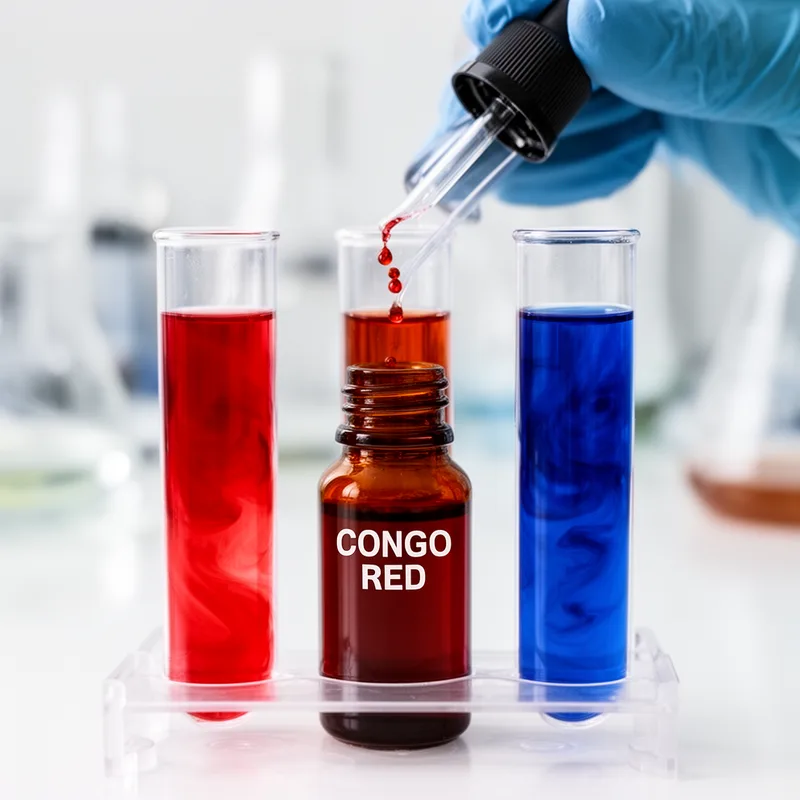
The experiment used Congo red dye to indicate the pH level of the solution.
-
As a pH indicator, Congo red changes color to red in basic and blue in acidic environments.
-
In our laboratory tests, Congo red effectively highlighted the changes in pH.
Surface Forms
Morphology
The compound pairs the place-name 'Congo' with the color 'red', so a B1 learner who knows both words could reasonably infer it refers to something that is red or named after Congo. However, the precise technical sense — an azo dye used as a pH indicator with specific color-change properties — is specialized and not predictable from the constituents alone, making the expression only partially transparent.
Etymology
Congo red comes from when chemists gave a new red dye the faraway place name Congo to make it sound special, and the word red simply shows its color. Today Congo red is the name for that lab 'stain' that can 'turn blue' in acid, so the name helps you remember both where it was called from and what it looks like.

