
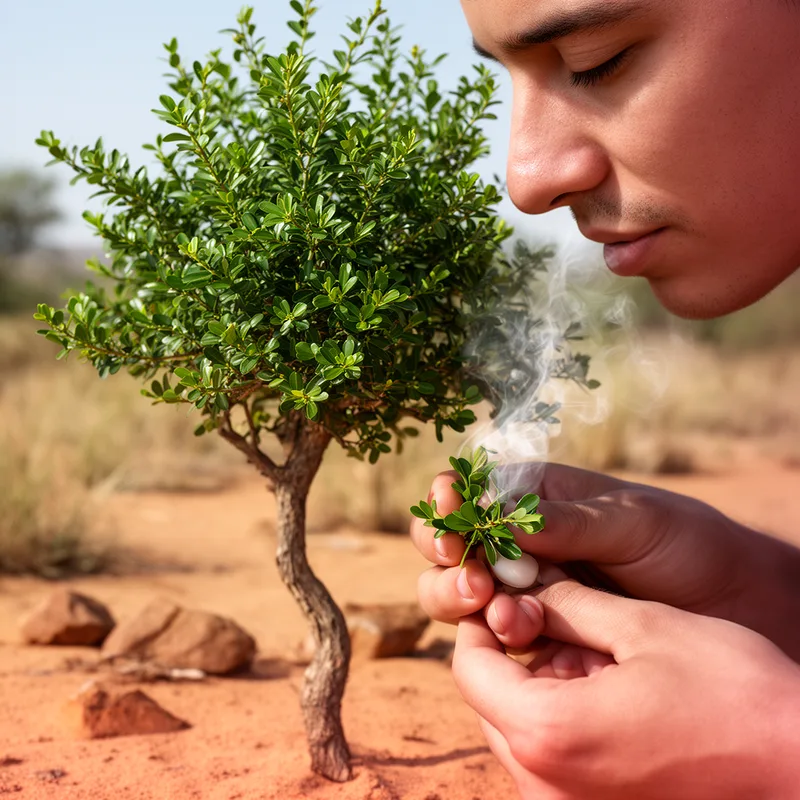
Commiphora meccanensis
- noun
- Specialized
- The leaves of the Commiphora meccanensis tree emit a strong aromatic odor when they are bruised.
Examples
-
The leaves of the Commiphora meccanensis give off a spicy scent when crushed.
-
The Commiphora meccanensis tree is known for its aromatic leaves.
-
In traditional medicine, extracts from Commiphora meccanensis trees are sometimes used to treat wounds.
-
Scientists are studying Commiphora meccanensis for its potential medicinal properties.
-
Have you ever seen a Commiphora meccanensis in the wild?
-
In Africa, people often use Commiphora meccanensis leaves for their pleasant fragrance in traditional rituals.
-
When you crush the leaves of Commiphora meccanensis, they release a distinct and aromatic smell.
Synonyms



 1
9.9
A group of trees and shrubs from Africa and India that make a scented resin like myrrh
Surface Forms
Morphology
Commiphora + meccanensis
This is a Linnaean binomial (genus + specific epithet): if a learner knows 'Commiphora' denotes a resin-producing tree, they can transparently infer that Commiphora meccanensis is a species of that tree. However, the specific epithet 'meccanensis' is likely toponymic/Latin and does not by itself convey the detailed properties (small evergreen, aromatic leaves), so the full meaning is not fully predictable from the parts.
Etymology
Commiphora meccanensis comes from two parts: the genus Commiphora means 'gum-bearer', used for plants that make a sticky gum, and the species meccanensis means 'from Mecca'. That's why the name fits this small evergreen tree whose bruised leaves or gum give a strong, spicy smell.