
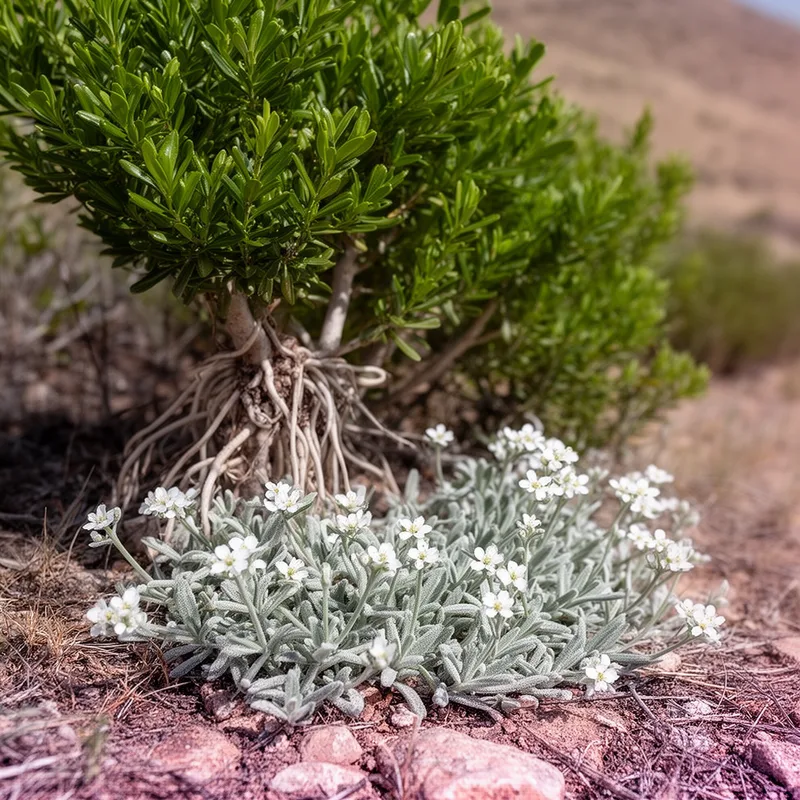
Comandra pallida
- noun
- Specialized
- I learned to identify Comandra pallida by its powdery leaves during our field trip.
Examples
-
Researchers studied the unique parasitic adaptations of Comandra pallida in western North America.
-
The arid slopes were dotted with Comandra pallida, blending in with the surrounding shrubs.
-
Look at this Comandra pallida!
-
The Comandra pallida is often found in dry, sandy soils.
-
During our hike, we spotted numerous clusters of small dull-white flowers from the Comandra pallida among the grasses.
-
The Comandra pallida thrives in dry environments, showcasing its thick powdery leaves to conserve moisture.
-
Botanists often collect samples of Comandra pallida to study its unique adaptations to parasitism.
Synonyms

A woody creeping plant that grows on other plants with thick powdery leaves and small dull white flowers
Surface Forms
Morphology
Comandra + pallida
The compound is a botanical binomial combining a plant genus name (Comandra) with an epithet 'pallida' (Latin for 'pale'), so a learner who knows both constituents can infer it denotes a pale species of Comandra. Although the full botanical description (woody, parasitic, etc.) is not derivable, the basic compositional sense 'pale Comandra (a plant)' is directly accessible from the parts.
Etymology
Comandra pallida probably combines the genus name Comandra and the Latin word pallida, which means 'pale'. That 'pale' picture matches the plant's dull-white flowers and powdery, light-coloured leaves, so the name helps you remember what the plant looks like.

