

Colobus
- noun
- /ˈkɒləbəs/
- Specialized
- Gombe chimps also hunt red colobus monkeys, but the percentage of group hunts is much lower: only 36 percent.
- Colobus monkeys
- red Colobus
Examples
-
Trying to escape, two colobus monkeys jumped into smaller trees lower in the canopy.
Academic text (1991) -
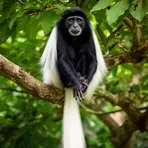
Researchers observed the unique patterns of the black-and-white coat of the colobus monkey in its natural habitat.
-
The six males moved on, and within five minutes, picked up the sounds of another group of red colobus.
Academic text (1991) -
Why not the shiny skin of a colobus monkey?
Fiction book (1991) -
Shortly after, we heard the characteristic cough of a red colobus monkey.
Academic text (1991) -
The relatively sluggish and large (almost thirty pounds) red colobus monkeys are the chimps' usual fare.
Academic text (1991) -
In the jungle, a group of red colobus monkeys moved gracefully through the trees, their long tails trailing behind them.
-
The red colobus monkeys are known for their vocalizations, often heard echoing through the forest as they communicate with each other.
Synonyms
 1
7.0
1
7.0

A monkey that lives in trees in Africa with long silky fur and small or no thumbs
Compounds
- South African
1
7.0
A monkey that lives in trees in Africa with long silky fur and small or no thumbs
Surface Forms
Etymology
Colobus comes from the Greek word kolobós, which means 'docked' or 'cut short', and this name was given because these monkeys have a very small or missing thumb. So the origin helps you remember that Colobus refers to a group of African monkeys known for their reduced thumb and striking coats.