
Coleridge
 4
8.9

- proper noun
- /ˈkoʊlərɪdʒ/
- Vallins argues that Coleridge examines the constructs of consciousness and mental functioning more deeply than any of his contemporaries.
- Samuel Taylor Coleridge
- Coleridge and Wordsworth
- Coleridge's Ode
Loading YouTube…
Watch on YouTubeAnd you know, Descartes comes up again later on as well in when she's praising Coleridge.
- And you know, Descartes comes up again later on as well in when she's praising Coleridge.
- And they're getting, they're getting their German philosophy in part through Samuel Coleridge, who's popularizing it at the time.
Examples
-
I only want to discuss Dante and Shakespeare, Wordsworth and Coleridge and Goethe.
-
The poet Samuel Taylor Coleridge was once asked why he attended so many chemistry lectures.
-
His position here is similar to that of S.T. Coleridge: every state should have an established religion, whatever that may be.
Academic text (1999) -
"Water, water everywhere, nor any drop to drink," wrote Samuel Taylor Coleridge.
Academic text (2002) -
I believe in what the great poet Samuel Taylor Coleridge thought were the cardinal rules of early education.
-
Indeed, we find Wordsworth himself congratulating Coleridge on his awareness of this fact.
Academic text (1997) -
I am ravished by the beauty of the great pagoda, like that "stately pleasure dome" Coleridge imagined.
Fiction book (2001) -
The poet Samuel Taylor Coleridge reported that he felt a pleasurable sensation of warmth, the desire to laugh, and an increased heartbeat.
-
Coleridge provides a dynamic example of fancy's "excursions" in a 1799 entry of his Notebooks.
Academic text (2017) -
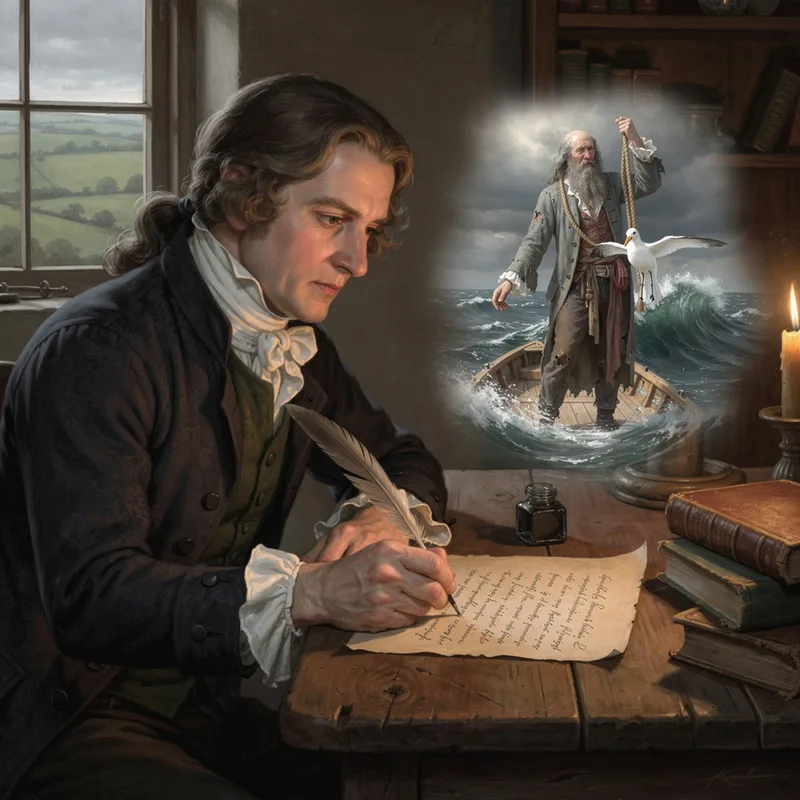
Samuel Taylor Coleridge is celebrated for his influential poem, "The Rime of the Ancient Mariner."
Synonyms
 1
8.4
An English poet from the Romantic period, known for The Rime of the Ancient Mariner and Kubla Khan
Surface Forms
Etymology
Coleridge likely comes from an old English place name made of coal and ridge, meaning 'a ridge where coal or charcoal was found'. So it began as a family or place name, which is why we use Coleridge to refer to the poet Samuel Taylor Coleridge.