
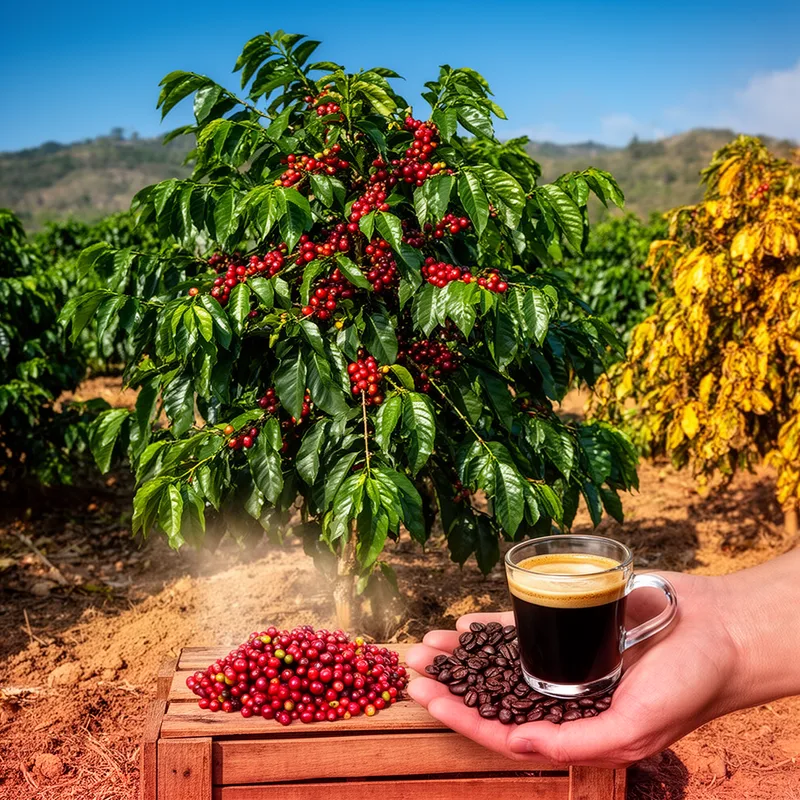
Coffea robusta
- noun
- /kəˈfiːə roʊˈbʌstə/
- Specialized
- Many instant coffees are made from Coffea robusta beans due to their strong flavor.
Examples
-
The farm switched to growing Coffea robusta because it is less susceptible to disease.
-
Many farmers prefer Coffea robusta for its high yield.
-
Researchers are studying Coffea robusta for its ability to thrive in harsher climates.
-
The Coffea robusta plant thrives in warmer climates.
-
Many instant coffees are made from Coffea robusta beans due to their strong flavor.
-
Farmers often choose Coffea robusta because the beans are resistant to pests and diseases.
-
In regions with higher temperatures, Coffea robusta is favored for its ability to adapt and produce good yields.
Synonyms

A coffee plant from West Africa that resists pests and makes strong-tasting beans

A coffee plant from West Africa that makes beans for strong coffee and resists disease
Surface Forms
Morphology
Coffea + robusta
The phrase is a scientific binomial combining the genus name Coffea (coffee) with the epithet robusta; a learner who knows 'Coffea' and that 'robusta' relates to 'robust/strong' can infer it denotes a type or species of coffee. However, the specialized biological naming convention and specific attributes (disease resistance, commercial use) are technical and not fully predictable from the constituents alone, so full meaning requires domain knowledge or exposure.
Etymology
Coffea robusta gets its name from the word 'robust', meaning 'strong' or 'hardy', because this coffee plant is tougher than other kinds and resists disease. That's why Coffea robusta is often used in instant and commercial coffees for its strong flavor and reliable crops.

