

Clematis verticillaris
- noun
- Specialized
- The Clematis verticillaris in her garden bloomed with striking purplish-blue flowers in late spring.
Examples
-
Gardeners often choose Clematis verticillaris for its ability to climb trellises and stone walls.
-
Unlike some other clematis species, Clematis verticillaris prefers cooler climates and well-drained soils.
-
The Clematis verticillaris blooms beautifully in early summer.
-
Have you seen the Clematis verticillaris in the garden?
-
Gardeners often choose Clematis verticillaris for its ability to climb trellises and adorn fences with its beautiful flowers.
-
The Clematis verticillaris in her garden bloomed with striking purplish-blue flowers that attracted many butterflies.
-
In northeastern North America, Clematis verticillaris is a popular choice due to its vibrant colors and climbing nature.
Synonyms

A climbing plant with purple flowers that grows on fences or walls

A climbing plant with waxy purplish-blue flowers
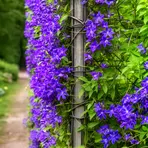
A climbing plant with waxy purple-blue flowers that grows on fences
Surface Forms
Morphology
clematis + verticillaris
Knowing 'clematis' makes it clear this is a type of plant (so part of the meaning is transparent), but 'verticillaris' is a Latin botanical epithet (not a common English word) and does not convey the specific properties (native range, waxy purplish-blue flowers) to a B1 learner. Species names are compositional in taxonomy (a kind of clematis) but the precise descriptive or geographic information is not predictable from the constituents, so the expression is only partly transparent.
Etymology
Clematis verticillaris gets its name from old Greek and Latin words: clematis comes from Greek meaning 'klema' or 'twig', and verticillaris comes from Latin meaning 'in a circle' or a 'ring'. So the name gives the image of a climbing plant ('vine') whose flowers or leaves form little rings, which matches how the plant looks today.

