
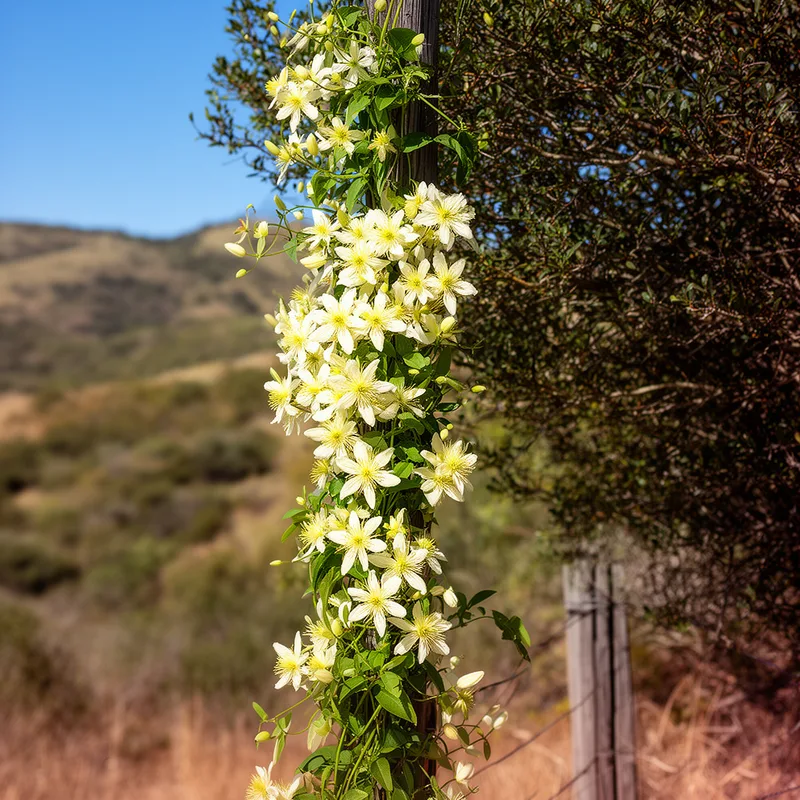
Clematis lasiantha
- noun
- Specialized
- Gardeners often choose Clematis lasiantha for its clusters of creamy-white flowers and climbing habit.
Examples
-
The Clematis lasiantha blooms in spring along the hillsides of southern California.
-
Hikers admired the clusters of Clematis lasiantha twining through the native chaparral.
-
Gardeners often choose Clematis lasiantha for its delicate, star-shaped flowers and climbing habit.
-
The Clematis lasiantha blooms beautifully in the spring.
-
Many gardeners love the Clematis lasiantha for its lovely flowers.
-
Hikers admired the clusters of Clematis lasiantha twining through the native chaparral in California.
-
The Clematis lasiantha blooms in spring, adding beauty to hillsides across southern California.
Surface Forms
Morphology
Clematis + lasiantha
This is a scientific binomial: knowing 'Clematis' (a flowering vine) lets a learner infer the phrase names a type of clematis, but the specific epithet 'lasiantha' is a non‑English/Latin element not found in the learner dictionary and does not transparently convey the species' properties. Therefore the combination gives partial information (that it is a clematis species) but not the full descriptive meaning, making it only partially predictable.
Etymology
Clematis lasiantha may come from old Greek words: Clematis meaning 'vine' and lasiantha from words meaning 'hairy' and 'flower', giving the image of a climbing plant with many small, soft flowers. That's why the name fits this climbing plant with clusters of creamy-white blooms.

