

Cladrastis lutea
- noun
- Specialized
- The Cladrastis lutea in our garden blooms with fragrant white flowers every spring.
Examples
-
Historically, wood from the Cladrastis lutea was used to produce a bright yellow dye.
-
Botanists admire Cladrastis lutea for its attractive foliage and ornamental value.
-
The Cladrastis lutea tree blooms beautifully in spring.
-
Have you seen a Cladrastis lutea in full bloom?
-
Gardeners appreciate Cladrastis lutea for its stunning clusters of white flowers in the spring.
-
In the past, artisans used the wood of the Cladrastis lutea to create vibrant yellow dye for textiles.
-
The Cladrastis lutea tree provides beautiful shade thanks to its rounded crown and rich foliage.
Synonyms

A small tree with white hanging flowers and yellow wood used for furniture
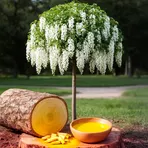
A small tree with a round top, white flower groups, and heavy wood used for yellow dye

A small tree with white flowers and hard wood used for yellow dye, named in the Bible
Surface Forms
Morphology
Cladrastis + lutea
This is a Linnaean binomial: knowing 'Cladrastis' (a genus of yellowwoods) lets a learner infer that the phrase names a kind/species of tree, so part of the meaning (that it is a Cladrastis tree) is compositional. However 'lutea' is presented as unknown (and is a Latin adjectival epithet meaning 'yellow'), so a typical B1 learner who only knows the given constituents would not recover the specific properties (deciduous habit, showy white flowers, yellow dye) without botanical or Latin knowledge. Because the genus label gives some transparent information but the species epithet and detailed senses are not accessible to learners, the expression is best classed as semi-transparent.
Etymology
Cladrastis lutea points to the tree's yellow wood: the second word lutea comes from an old word meaning 'yellow' because people used its wood to make a bright yellow dye. So the name helps you remember a small tree with showy white flowers and wood that gives a yellow colour.

