
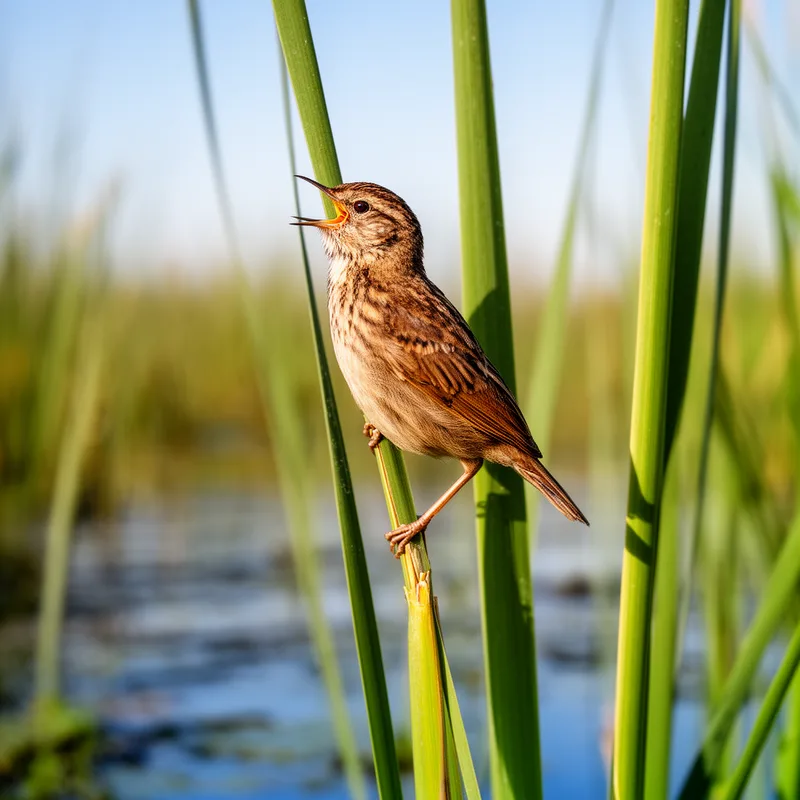
Cistothorus palustris
- noun
- /ˌsɪstəˈθɔrəs pəˈlʌstrɪs/
- Specialized
- The Cistothorus palustris is often heard singing amid the cattails of North American wetlands.
Examples
-
Scientists observed the nesting behavior of Cistothorus palustris in restored marsh habitats.
-
Birdwatchers frequently seek out Cistothorus palustris for its distinctive bubbling song.
-
The Cistothorus palustris is often found in wetland areas.
-
Have you ever seen a Cistothorus palustris in its natural habitat?
-
Birdwatchers frequently seek out Cistothorus palustris for its distinctive bubbling song.
-
Scientists observed the nesting behavior of Cistothorus palustris in restored marsh habitats.
-
The Cistothorus palustris is often heard singing amid the cattails of North American wetlands.
Synonyms

A small songbird that lives in marshes and sings a loud bubbling song
Surface Forms
Morphology
Cistothorus + palustris
This is a taxonomic binomial: the genus 'Cistothorus' already denotes small wetland wrens, so part of the meaning (a kind of wren) is recoverable from the constituents. However the species epithet 'palustris' is Latin and absent from the provided dictionary entry; interpreting it as ‘marsh-dwelling’ requires specialist or Latin knowledge and knowledge of scientific naming conventions, which a B1 learner is unlikely to have. Because one constituent gives a clear cue but the full interpretation depends on technical/Latin knowledge, the expression is only partially transparent.
Etymology
The name Cistothorus palustris comes from older words that describe a small songbird of wet places: palustris means 'of the marsh', and Cistothorus suggests a bird that 'lives and sings in reeds'. So the name fits the bird we now call the 'marsh wren', because it lives and sings in tall reeds and marshes.

