
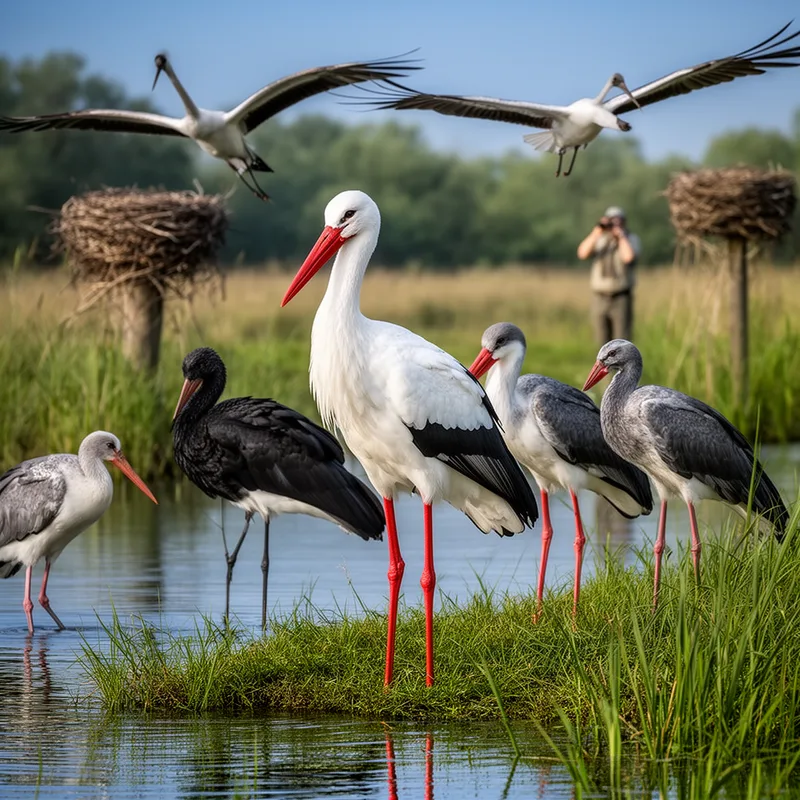
Ciconia
- proper noun
- Specialized
- On the Buka Islands off the coast of New Guinea, there has recently been observed an unexplained surge in the population of the genus Ciconia ciconia, commonly known as the Indonesian stork.
- Latin Ciconia
Examples
-
The Ciconia is often seen wading in shallow waters, searching for fish and amphibians.
-
Birdwatchers are excited to spot a rare Ciconia in the wetlands this season.
-
Rather, these forms most likely represent a split into different directions from Latin CICONIA.
Academic text (1993) -
Let us assume, then, that the first step in the Castilian development too was CICONIA > *kekonja.
Academic text (1993) -
The formal development of Latin CICONIA to Sp. ciguena is anomalous in almost every respect.
Academic text (1993) -
The linguistic divergence from Latin CICONIA, and later convergence and blending of the multiple variants, may be schematized as follows:
Academic text (1993) -
In other words, if Latin CICONIA had played strictly by the rules of historical phonology, the Spanish word for "stork" would be either *cegona, *ceguna, or *cegoina, but not ciguena.
Academic text (1993) -
Only if one were to posit *-oinja, as did Lathrop (104) and Hanssen (40), would a uni-linear scheme lead us from CICONIA to ciguena.
Academic text (1993) -
The genus Ciconia includes several impressive stork species known for their great migratory patterns.
Compounds
- Specialized
A large white stork with black wings and a red beak that lives in Europe
Surface Forms
Etymology
Ciconia is a scientific name taken from Latin ciconia, meaning 'stork', and from the Greek kikōnía, so it names a group of large stork species.

