
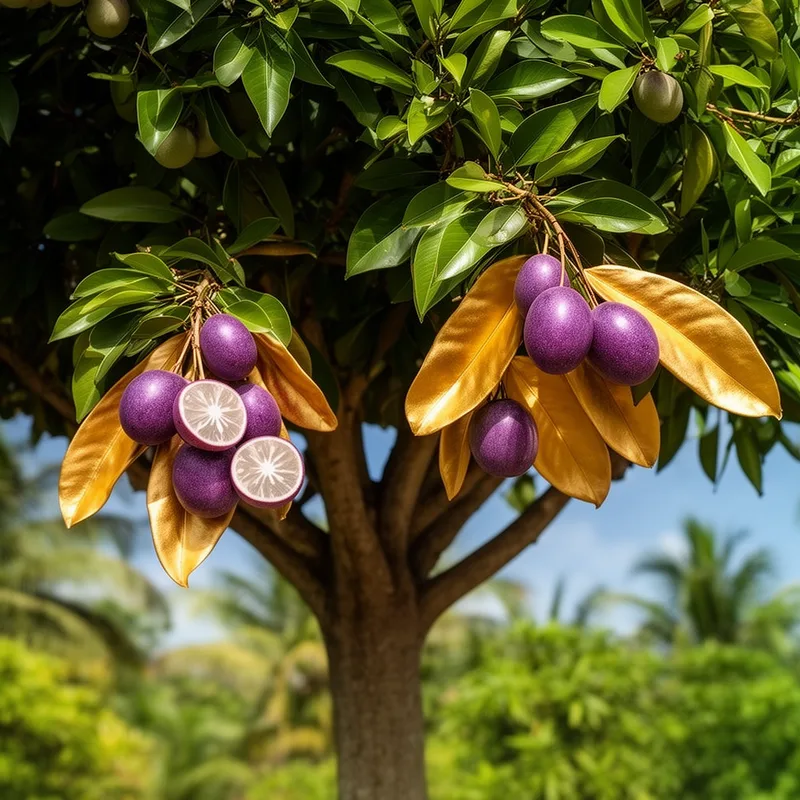
Chrysophyllum cainito
- noun
- Specialized
- The fruit of the Chrysophyllum cainito is prized for its sweet, juicy flesh in many tropical countries.
Examples
-
The silky golden underside of the Chrysophyllum cainito leaf makes the tree easy to identify.
-
The Chrysophyllum cainito tree thrives in tropical climates.
-
Gardeners in the Caribbean often plant Chrysophyllum cainito for its ornamental foliage and edible fruit.
-
I saw a Chrysophyllum cainito at the botanical garden.
-
Gardeners in the Caribbean often plant Chrysophyllum cainito for its ornamental foliage and edible fruit.
-
The fruit of the Chrysophyllum cainito is prized for its sweet, juicy flesh in many tropical countries.
-
The silky golden underside of the Chrysophyllum cainito leaf makes the tree easy to identify.
Synonyms
An evergreen tree from the Caribbean with purple fruit you can eat that forms a star when cut
A tropical tree that makes a sweet purple fruit with a star shape inside when cut
Surface Forms
Morphology
Chrysophyllum + cainito
This is a scientific binomial: knowing 'Chrysophyllum' (a genus of tropical trees with edible fruit) lets a learner infer that the phrase names a kind of tree or fruit-bearing plant, but the species epithet 'cainito' is not interpretable and the specific attributes (evergreen habit, purple star-shaped fruit, golden leaf undersides) are not derivable from the parts. Because some general meaning (a type of tree) is transparent but the detailed sense is not, the expression is only partially transparent to a B1 learner.
Etymology
Chrysophyllum cainito comes from old Greek words: Chrysophyllum means 'gold leaf' because the underside of its leaves looks golden, and cainito is the local name for the fruit often called the 'star apple'. So the name points to a tree with shiny golden leaf undersides and a fruit that shows a star when you cut it.

