
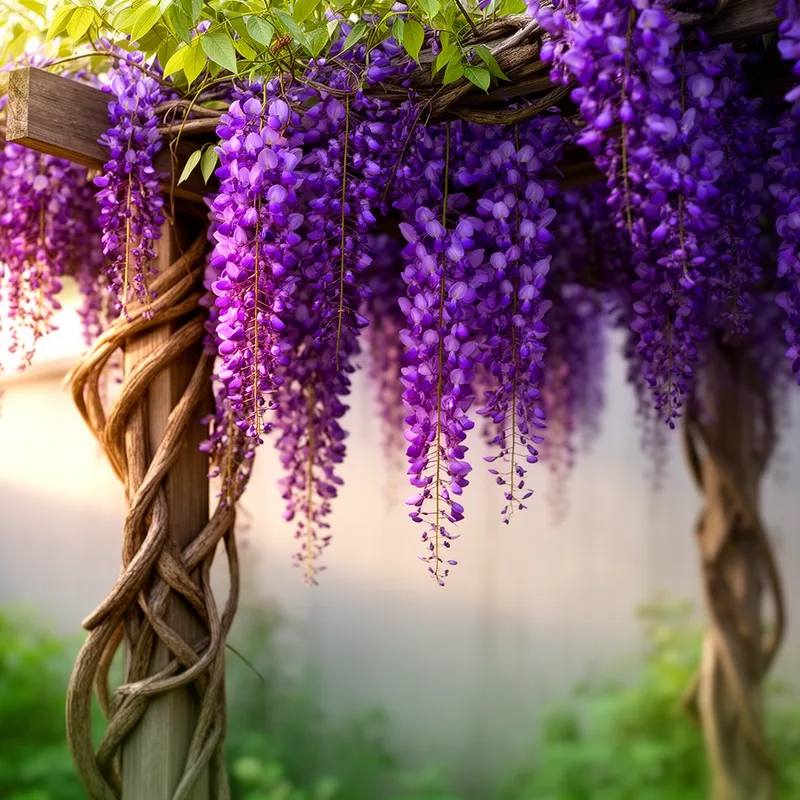
Chinese wistaria
- noun
- /ˈtʃaɪniːz wɪˈsteəriə/
- A vine of Chinese wistaria can quickly cover fences and trellises with its cascading flowers.
Examples
-
We planted a young Chinese wistaria to provide shade and color for our pergola.
-
The Chinese wistaria bloomed beautifully along the old garden wall this spring.
-
The Chinese wistaria blooms beautifully in spring.
-
Have you seen the Chinese wistaria in the garden?
-
A vine of Chinese wistaria can quickly cover fences and trellises with its cascading flowers.
-
The Chinese wistaria bloomed beautifully along the old garden wall this spring.
-
We planted a young Chinese wistaria to provide shade and color for our pergola.
Synonyms

 4
7.4
4
7.4

A climbing plant with hanging purple or white flowers grown for decoration

A climbing plant from China with long hanging clusters of purple, sweet-smelling flowers
Surface Forms
Morphology
Chinese + wistaria
The phrase is a straightforward adjective + noun construction: 'Chinese' specifies origin or variety of the plant 'wistaria', so a learner who knows both constituents can infer it denotes the Chinese variety of that climbing plant. This kind of modifier–noun compositional pattern is cross-linguistically common (and remains transparent even if 'wistaria' is a less common or variant spelling), so the meaning is directly derivable from the parts.
Etymology
Chinese wistaria may come from its home in China and from a man named Wistar who gave his name to wistaria. Its long purple flowers hang down like a waterfall, so today Chinese wistaria means 'a climbing plant with long, hanging purple flowers'.