
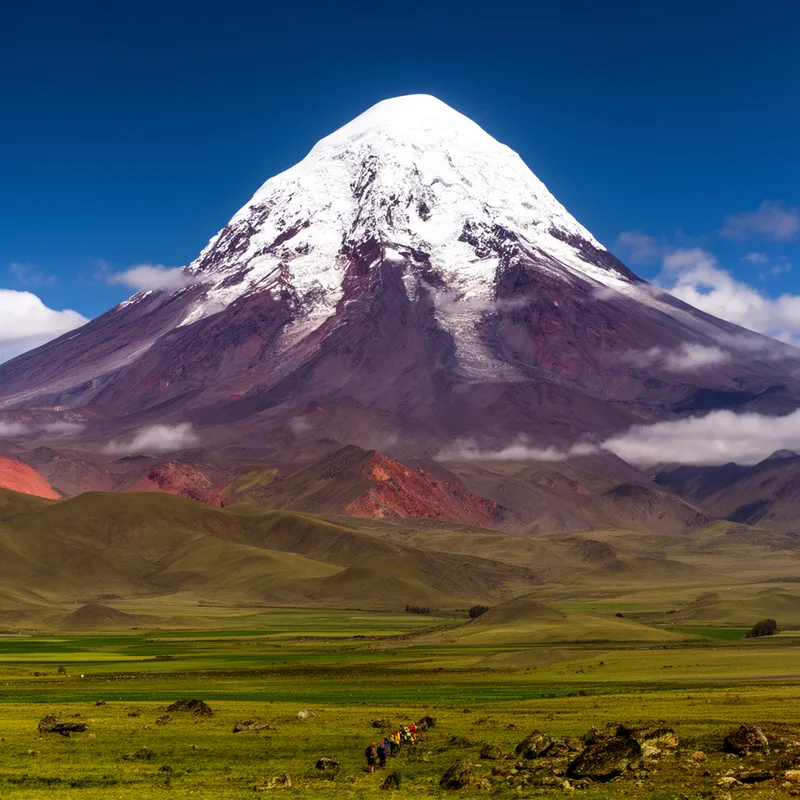
Chimborazo


 1
9.2
- proper noun
- Some observers estimated that as much as 40 percent of Chimborazo Province was evangelical or Pentecostal.
- Chimborazo province
Examples
-
A final illustration is taken from Licto, Chimborazo Province, Ecuador.
Academic text (2008) -
Fieldwork and archival research were conducted in Chimborazo from 1989 to 1992 and more briefly during the summers of 1995 and 1996.
Academic text (2001) -
Despite the apparent contradiction between these approaches, both have proved useful, and both could find some support in Chimborazo.
Academic text (2001) -
It is still practiced in other parts of Chimborazo province, at least in the early 1990s.
Academic text (2001) -
The agrarian reform initiated in the 1960s radically transformed the social landscape of the Pangor Valley and Chimborazo.
Academic text (2001) -
Although liberation theology has reshaped indigenous religious consciousness and practice in Chimborazo, an active historical memory continues to influence contemporary religious thinking, and part of that reshaping necessarily takes the form of reinterpreting the past.
Academic text (2001) -
In Chimborazo during 1900-1950, malaria spread into highland valleys along the railway linking Guayaquil and Quito (10, 17, 18).
Academic text (2012) -
As in much of rural Latin America prior to Vatican II, local religion in Chimborazo revolved around calendrical fiestas, especially feasts honoring local patron saints.
Academic text (2001) -
Ashfall, pyroclastic flows, lahars, and incandescent material affected roughly 650,000 people in Tungurahua and Chimborazo provinces.
Academic text (2017) -
Climbing Chimborazo is a challenging adventure that attracts mountaineers from around the world.
Surface Forms
Etymology
Chimborazo comes from the local Quechua language, probably from chimba meaning 'on the other side' and rasu meaning 'snow' or 'ice'. So the name is like calling it the 'snowy mountain on the other side', which fits this high, snow-capped peak in central Ecuador.