

Chimaphila corymbosa
- noun
- Specialized
- Gardeners sometimes cultivate Chimaphila corymbosa for its attractive pinkish corymbs.
Examples
-
The rare Chimaphila corymbosa was found blooming along the forest's edge in early summer.
-
The Chimaphila corymbosa blooms in early spring.
-
Botanists noted the white flowers of the Chimaphila corymbosa during their field survey.
-
Did you see the Chimaphila corymbosa in the garden?
-
The rare Chimaphila corymbosa was found blooming along the forest's edge in early summer.
-
Gardeners sometimes cultivate Chimaphila corymbosa for its attractive pinkish corymbs.
-
Botanists noted the white flowers of the Chimaphila corymbosa during their field survey.
Synonyms

A small plant with white or pink flowers that blooms in late winter
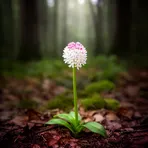
A small plant from Europe and Asia with white or pink flowers in a cluster at the top
Surface Forms
Morphology
Chimaphila + corymbosa
This is a botanical Latin binomial combining a genus name ('Chimaphila' = a small genus of evergreen herbs) with an adjectival epithet that indicates a morphological trait; if a learner knew 'corymbosa' (from 'corymb' = a cluster of flowers) they could compositionally infer 'a Chimaphila with corymbs'. However, 'corymbosa' is technical/Latin and not found in common dictionaries, so an average B1 learner—even knowing the genus label—would likely not be able to derive the specific floral-cluster sense without prior exposure.
Etymology
Chimaphila corymbosa comes from old Greek and Latin words: Chimaphila means 'winter-loving' because these plants stay green in winter, and corymbosa means 'with corymbs', a flat-topped cluster of flowers. So the name tells you it's a plant that stays green in winter and has a top cluster of flowers.

