
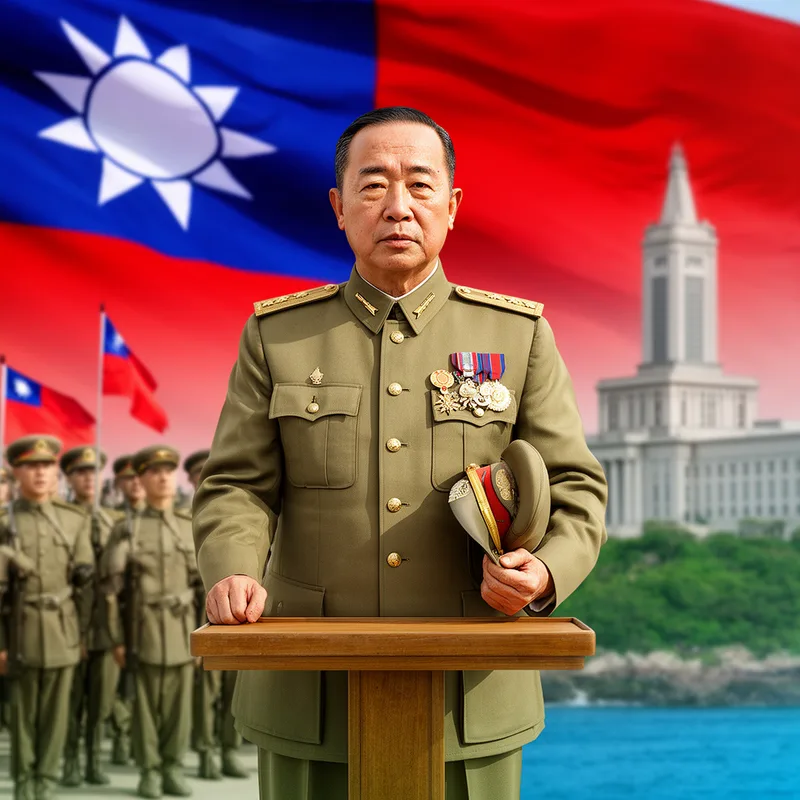
Chiang Kai-shek
 4
9.3

- proper noun
- /ˈtʃjɑŋ kaɪ ˈʃɛk/
- Chiang Kai-shek died at the age of eighty-seven.
- Chiang Kai-shek
- Chiang Kai-shek's Nationalist government
Examples
-
For four decades since the Nationalists withdrew from mainland China, the island was ruled by Chiang Kai-shek and his son Ching-kuo, who never gave up hope of returning to their home.
Academic text (1997) -
When Chiang Kai-shek and his government fled to China's island territories, including the big island of Taiwan, some two million mainland Chinese followed, including over half a million soldiers loyal to Chiang Kai-shek.
Academic text (1997) -
Chiang Kai-shek held that all Chinese must identify themselves as descendants of the Yellow Emperor.
Academic text (1997) -
On 5 April 1975, Chiang Kai-shek died on Taiwan, and with him passed an era of Taiwanese history that looked forever back to the mainland.
Academic text (1997) -
In an interview, Chiang Kai-shek said, "Our friends in the U.S. and other free countries must realize that the existence of Free China, Taiwan, is based upon the conviction that free society must in the end triumph over the Communist system of slavery."
Academic text (1999) -
Those generous assistance programs helped Chiang Kai-shek build an underdeveloped island into a prosperous and modern industrialized state.
Academic text (1997) -
There was no need to worry about Taiwan's independence in the 1950s because Chiang Kai-shek's Nationalist government had no intention of giving up the dream of returning to the mainland.
Academic text (1997) -
But the Kuomintang clique, headed by Chiang Kai-shek, flouted the people's fervent aspirations for peace and for building an independent, democratic, and prosperous new China.
Academic text (1999) -
A few months later, on May 1, Taiwan terminated its "Period of Mobilization for the Suppression of the Communist Rebellion," an old law dating from the days of Chiang Kai-shek, and thus officially ended the state of hostility toward the mainland.
Academic text (1997) -
Chiang Kai-shek served as the leader of the Nationalist government in Taiwan after fleeing from the mainland.
Synonyms

A Chinese military and political leader who led the Nationalists and moved the government to Taiwan in 1949
Surface Forms
Morphology
Chiang + Kai-shek
This is a proper name referring to a specific historical person; the constituent parts are name segments (and not lexical words with compositional meaning in English), so knowing the parts does not allow a learner to infer the biographical referent or role. Proper names are arbitrary referents that require world knowledge rather than compositional decoding, making comprehension non-derivable from the parts.
Etymology
Chiang Kai-shek is how Western books long ago wrote a Chinese name; Chiang is the 'family name' and Kai-shek is the 'personal name'. So, Chiang Kai-shek refers to the Nationalist leader who lost to the communists and moved to Taiwan in 1949.