
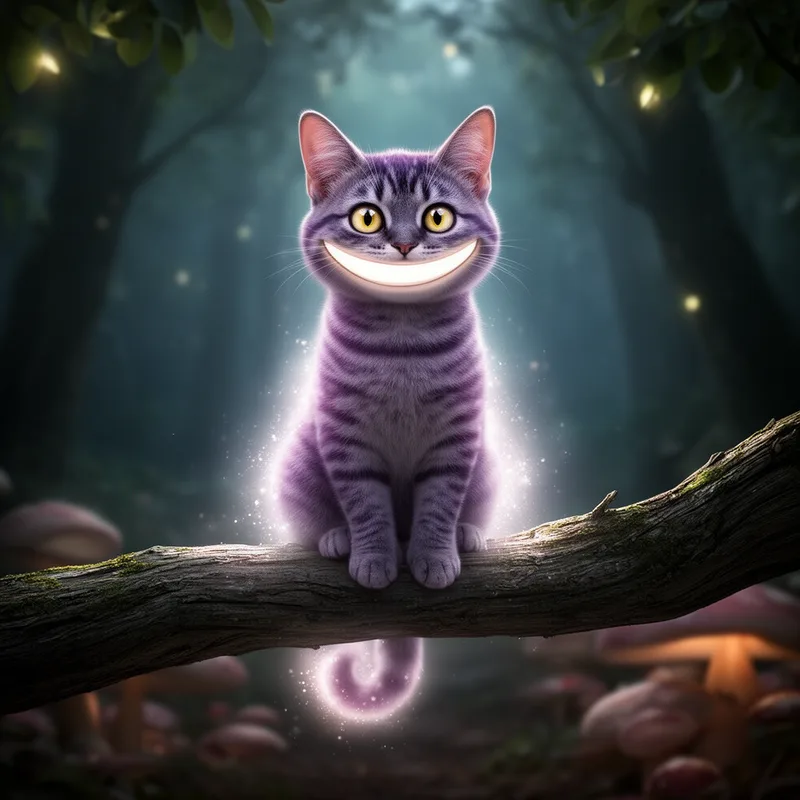
Cheshire cat
 3
7.9
3
7.9

- noun
- /ˈtʃɛʃɪr kæt/
- Literature
- With a Cheshire cat smile, he revealed only part of his secret, making everyone curious.
Examples
-
I can't walk round grinning like a Cheshire cat.
-
Recall her encounter with a mischievous, disappearing Cheshire cat:
Academic text (1994) -
- It's the Cheshire cat.
-
What are you two smiling like Cheshire cats for, huh?
-
One day Alice came to a fork in the road and saw a Cheshire cat in a tree.
Blog text (5) -
Then, her dominance firmly established, she releases his hand with a coy, Cheshire-cat smile.
Fiction book (1992) -
For example, Carroll's Cheshire Cat repeatedly encourages Alice toward risky adventures.
Academic text (1999) -
Shortly before the Mad Hatter's tea party in Alice in Wonderland (1865), the eponymous heroine encounters the Cheshire Cat in the woods.
Academic text (1997) -
In the book, the Cheshire cat disappears, leaving only its broad smile behind.
-
The girl felt as if she was talking to the Cheshire cat when the mysterious figure grinned at her.
Surface Forms
Morphology
Cheshire + cat
This is the proper name of a literary character rather than a compositional phrase; knowing the constituents 'Cheshire' (a toponym) and 'cat' does not let a learner infer the character's iconic broad grin and mysterious, vanishing behaviour. The meaning is a culture-specific literary reference and therefore unpredictable for a B1 learner who has not encountered the expression.
Etymology
Cheshire cat comes from Lewis Carroll's book 'Alice's Adventures in Wonderland', where a cat appears and slowly disappears, sometimes leaving only its wide, fixed smile. Because of that strange image, the name now means 'a person with a mysterious, very wide smile' or someone who behaves in a puzzling, hard-to-read way.