
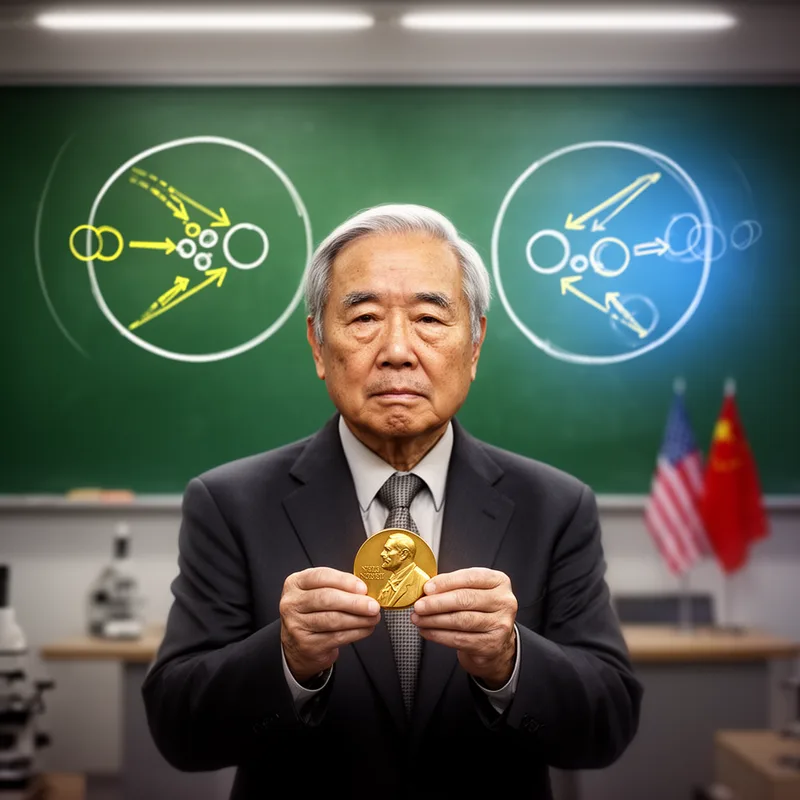
Chen-Ning Yang


 1
9.6
- proper noun
- /tʃɛn nɪŋ jæŋ/
- Chen-Ning Yang won the Nobel Prize in Physics in 1957 for his work on parity violation.
Examples
-
Dr. Chen-Ning Yang was awarded the Nobel Prize in Physics in 1957.
-
As a young scientist, Chen-Ning Yang moved from China to the United States to pursue further research.
-
Many universities have honored Chen-Ning Yang for his groundbreaking contributions to theoretical physics.
-
Have you read about Chen-Ning Yang's contributions to particle physics?
-
Chen-Ning Yang won the Nobel Prize in Physics in 1957 for his work on parity violation.
-
Many universities have honored Chen-Ning Yang for his groundbreaking contributions to theoretical physics.
-
As a young scientist, Chen-Ning Yang moved from China to the United States to pursue further research.
Surface Forms
Morphology
Chen-Ning + Yang
This is a proper name referring to a specific individual; knowing the constituent name tokens does not let a B1 learner infer the biographical/professional meaning (Chinese‑American physicist, Nobel laureate). Proper nouns are referential and require world knowledge rather than compositional interpretation, so the meaning is not derivable from the parts.
Etymology
Chen-Ning Yang is a Chinese-American physicist famous for a 1957 discovery with Tsung-Dao Lee: they showed that tiny particles do not always behave the same as their mirror image—imagine a left hand and its mirror moving in different ways. That's why his name is linked to the idea of nature's 'mirror symmetry' being broken and why he won the Nobel Prize.