
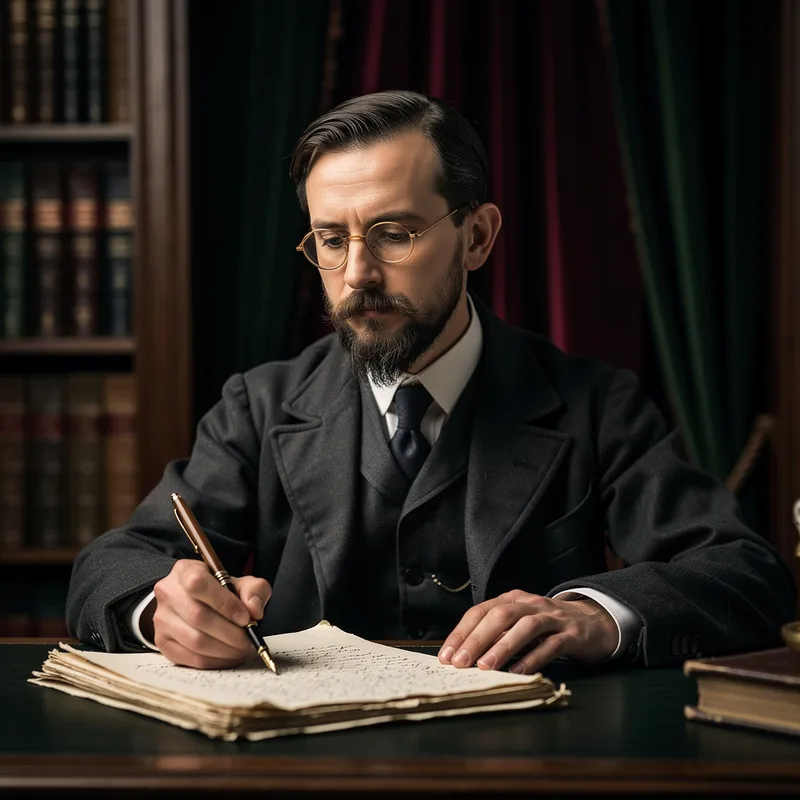
Chekhov
 16
5.7

- proper noun
- /ˈtʃɛkɒf/
- Literature
- Many students study Chekhov in literature classes to analyze his themes.
- Chekhov short story
- Anton Chekhov
- Chekhov's characters
Loading YouTube…
Watch on YouTubeIs it the pistol on the mantelpiece in a Chekhov play?
- Is it the pistol on the mantelpiece in a Chekhov play?
- The playwright Anton Chekhov says indifference is a paralysis of the soul, a premature death.
- Let's just silently watch and, and you know, the, all the art that came out of that, you know, the Stanislavsky and Chekhov, that was radical in its time.
- Every time I read Chekhov and his unique vision of human life, I'm reminded of why I, too became a writer.
- And the first job that I got in the theater was to be in the little, the little Natasha in the three sisters, the Chekhov play.
- And to quote my culture hero Anton Chekhov, he said.
- And some of these other thinkers as well, like like Chekhov and and Ibsen and and Tolstoy.
- I want you to let go of everything in the past like Chekhov did.
- I read my way through Dostoevsky, Tolstoy, Turgenev, I Chekhov.
Examples
-
Three troupes participated, including the Modern Theater troupe, which presented Anton Chekhov's play Uncle Vanya with great success.
Academic text (1997) -
As a matter of fact, I prefer Chekhov to Shakespeare.
-
Tell me about the Chekhov play you read.
-
Hey, I see you got the Chekhov book I told you about, huh?
-
"Next time read me another Chekhov story, OK?" said Bob.
Fiction book (1998) -
So where did you find that Chekhov quote?
-
Have you ever read Chekhov?
-
She's coming to do the Chekhov play at Saugatuck, remember?
-
You know, "The Cherry Orchard" was Chekhov's last play.
-
I was inspired by Chekhov's ability to convey deep feelings in simple words.
Synonyms
 2
5.8
A Russian writer of plays and short stories famous for writing about people and their relationships

 1
6.5
A Russian writer who wrote plays and short stories about human relationships
Surface Forms
Etymology
Chekhov is a Russian family name made from Чех 'Czech' and the ending -ov 'belonging to', so it originally meant 'of a Czech'. That's why Chekhov now names the famous Russian writer Anton Chekhov and his plays and stories.