
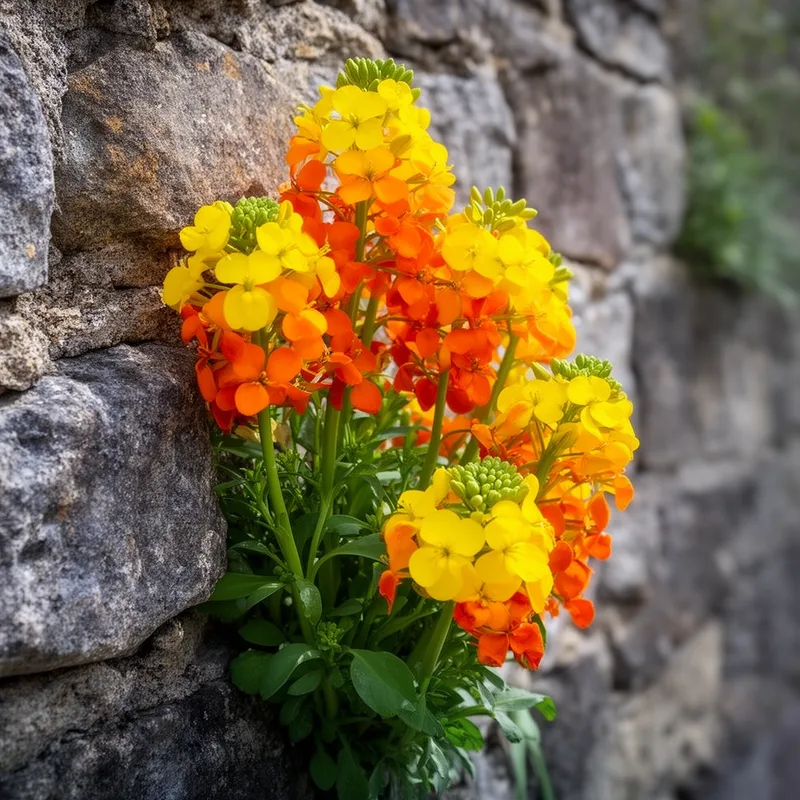
Cheiranthus cheiri
- noun
- Specialized
- The old stone walls were covered in Cheiranthus cheiri in early spring, creating a splash of yellow and orange.
Examples
-
Gardeners often plant Cheiranthus cheiri for its long-lasting fragrance and vivid blossoms.
-
Botanists sometimes debate whether Cheiranthus cheiri should instead be placed in the genus Erysimum.
-
Look at the beautiful Cheiranthus cheiri!
-
The Cheiranthus cheiri blooms beautifully in spring.
-
Gardeners often plant Cheiranthus cheiri for its long-lasting fragrance and vivid blossoms.
-
The old stone walls were covered in Cheiranthus cheiri in early spring, creating a splash of yellow and orange.
-
The Cheiranthus cheiri is commonly found thriving on cliffs and old walls throughout southern Europe.
Synonyms
 2
6.0
2
6.0

A small plant with a sweet smell and yellow or orange blooms that grows on old walls
A plant with bright yellow or orange fragrant flowers that often grows on old walls
Surface Forms
Morphology
Cheiranthus + cheiri
This is a Latin binomial (scientific) name rather than a normal English compositional phrase; the second element 'cheiri' is not an English word and the genus-species convention is not something a B1 learner can use to infer the common meaning 'wallflower'. Even if 'Cheiranthus' is glossed as a flowering plant, the taxonomic form and unfamiliar Latin epithet make the overall meaning non-compositional and unpredictable for typical learners.
Etymology
Cheiranthus cheiri is better known as the 'wallflower' because it often grows from cracks in old stone walls and on cliffs, making bright, fragrant patches. That's why its name reminds you of a small flower on a wall and helps you remember where it likes to grow.