
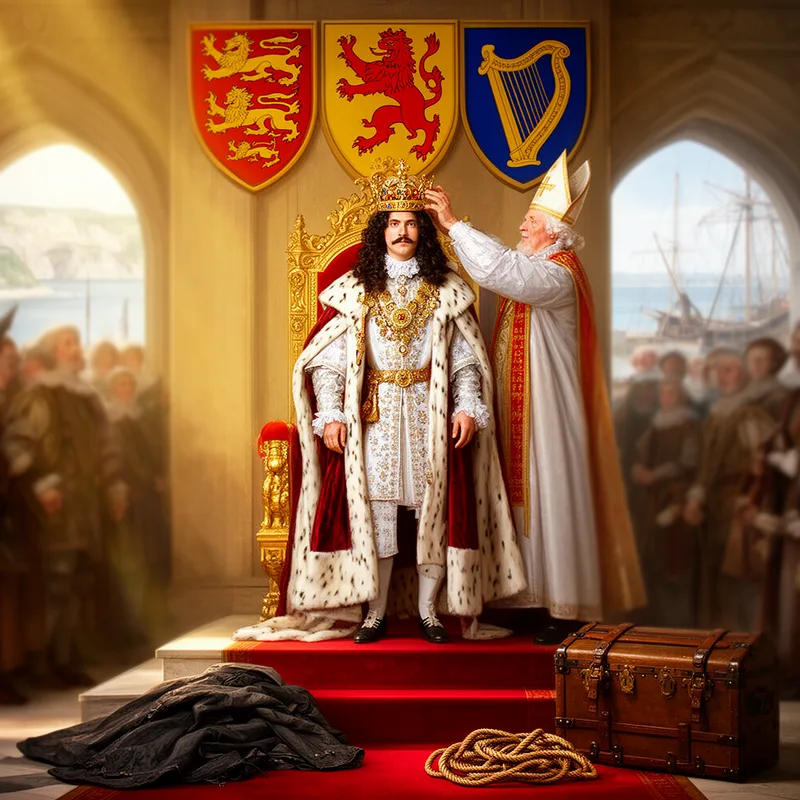
Charles II
 3
6.7

- proper noun
- /ˈtʃɑrlz ˈðə ˈsɛkənd/
- Such swift alterations were vital as in a few days' time these very ships would be bringing Charles II home in triumph.
- King Charles II
Examples
-
In 1672, Charles II created him Duke of Lauderdale and bestowed upon him the coveted Order of the Garter.
Academic text (2010) -
In the 1660s, Charles II's foreign policy was, on the other hand, marked by retreat and humiliation.
Academic text (2010) -
On 3 May 1661, an event of immense importance took place in London: the coronation of King Charles II.
Academic text (2006) -
In the middle of May 1660, as the Restoration of Charles II became inevitable, hasty changes were made to the British fleet lying off the coast of the Low Countries.
Academic text (2010) -
In England, the humiliating defeat and the capture of the Royal Charles led to an eruption of anger against Charles II and his government, a marked contrast to the celebrations that had greeted his restoration seven years before.
Academic text (2010) -
After the Restoration, the Royal Charles became the flagship of the Royal Navy, and she continued to play a symbolic role, leading, for example, the squadron that went to Lisbon to collect Charles II's bride, the Portuguese princess Catherine of Braganza, in 1662.
Academic text (2010) -
The royal touch was not practiced during the Interregnum, but its reintroduction by Charles II was met with unprecedented enthusiasm; he touched at least 96,000 people during his reign, partly because James had 'Protestantized' the ceremony and partly as a reaction against the 1650s.
Academic text (2011) -
In 1660, the Scots greeted the Restoration of Charles II to the English, Scottish, and Irish thrones of his father with widespread joy, but this delight did not extend to the accompanying re-establishment of episcopacy in the Scottish Kirk.
Academic text (2010) -
On 3 May 1661, an event of immense importance took place in London: the coronation of King Charles II.
-
During his reign, King Charles II worked to restore stability to England after years of civil conflict.
Synonyms

 1
7.5
King of England, Scotland, and Ireland who brought back the monarchy in 1660 after years without a king
Surface Forms
Morphology
Charles + II
The components ('Charles' as a personal name and 'II' as the Roman numeral for 'the second') transparently indicate a person called 'Charles the Second' and follow a common cross-linguistic naming convention, so learners will recognise it as the second Charles. However, the specific historical identity and role (King of England, Scotland, and Ireland during the Restoration) are encyclopedic and not derivable from the parts, so full interpretation requires prior world knowledge.
Etymology
Charles II is the king's name Charles plus the number II, which means he was the 'second' king with that name. He is famous for coming back to England in 1660 after years away and being 'restored' to the throne, so remember him as the king who returned to rule.