

Chalcedon
 1
9.9
1
9.9

- proper noun
- Even by the time of Chalcedon (451 C.E.), Jesus' full divinity and humanity could be affirmed but not conclusively explained.
- Council of Chalcedon
- Fathers of Chalcedon
- decisions of Chalcedon
Loading YouTube…
Watch on YouTubeIn this case, it's Apollonius of Chalcedon, the professor of Stoicism who teaches in Athens.
- In this case, it's Apollonius of Chalcedon, the professor of Stoicism who teaches in Athens.
Examples
-
The bishops at Constantinople repeatedly declared their loyalty to the Council of Chalcedon (canons 5, 6, 11, and 14).
Academic text (1991) -
Cotter started gathering his fleet in Chalcedon, but was too slow.
-
The goal is not to translate Nicea or Chalcedon.
Academic text (1991) -
For 240 years after the Council of Chalcedon (451), no ecumenical council had issued any norms of church discipline.
Academic text (2010) -
The formulas from the councils of Nicaea and Chalcedon, and the Cappadocian Fathers' trinitarian terminology constitute the foundation of classic orthodoxy.
Academic text (2001) -
Chalcedon's formulation was necessary to combat Eutychianism, while Cyril's language was important to repudiate the Mopsuestian-Nestorian tendency.
Academic text (1991) -
Most notably, Leo and subsequent pontiffs had refused to acknowledge the 28th canon of Chalcedon, which had accorded the see of Constantinople "equal prerogatives" with elder Rome and assigned her second rank.
Academic text (2009) -
The early ecumenical councils (Nicea, 325 A.D.; Constantinople, 381 A.D.; and Chalcedon, 451 A.D.) were heavily influenced by theologians from Africa.
Academic text (1996) -
In 451 AD, the important Council of Chalcedon established key doctrines of Christian theology.
-
The legacy of the Council of Chalcedon can still be seen in many modern Christian beliefs.
Synonyms

A district in Istanbul by the sea with lively markets and restaurants
Compounds
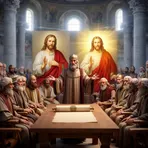
A meeting in 451 where church leaders say that Jesus is both human and divine
Surface Forms
Etymology
Chalcedon comes from the old Greek name Khalkedon, which is linked to khalkos meaning 'copper' or 'bronze'. Think of a seaside town of metal workers, and remember that the ancient town is now part of modern Istanbul.