
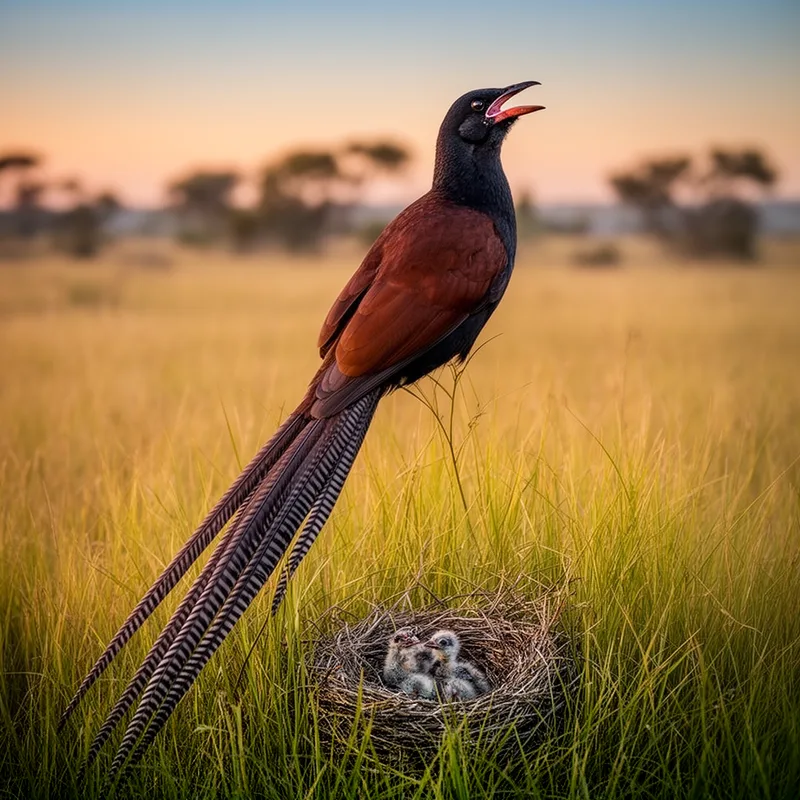
Centropus phasianinus
- proper noun
- Specialized
- Unlike most cuckoos, the Centropus phasianinus builds its own nest and raises its young.
Examples
-
The Centropus phasianinus is often seen skulking through tall grasslands in northern Australia.
-
During the summer, the Centropus phasianinus can be heard calling at dawn and dusk.
-
The Centropus phasianinus is often found in dense vegetation.
-
Look at the Centropus phasianinus!
-
During the summer, the Centropus phasianinus can be heard calling at dawn and dusk.
-
The Centropus phasianinus is often seen skulking through tall grasslands in northern Australia.
-
Unlike most cuckoos, the Centropus phasianinus builds its own nest and raises its young.
Synonyms

A large Australian bird in the cuckoo family with a long tail like a pheasant
Surface Forms
Morphology
Centropus + phasianinus
This is a scientific binomial formed from a genus name (Centropus) plus a Latin-derived specific epithet (phasianinus) that literally means 'pheasant-like'. If a learner already knew the Latin/derivational meaning of 'phasianinus' they could deduce 'a pheasant-like Centropus', but the epithet is not a regular English word and requires etymological or taxonomic knowledge beyond B1, so the relation is only partially transparent.
Etymology
Centropus phasianinus comes from old name parts: Centropus meaning 'spurred foot' and phasianinus meaning 'pheasant-like'. People who named the bird saw its strong feet and long, showy tail like a pheasant, so the name helps you remember this cuckoo's pheasant-like look.

