
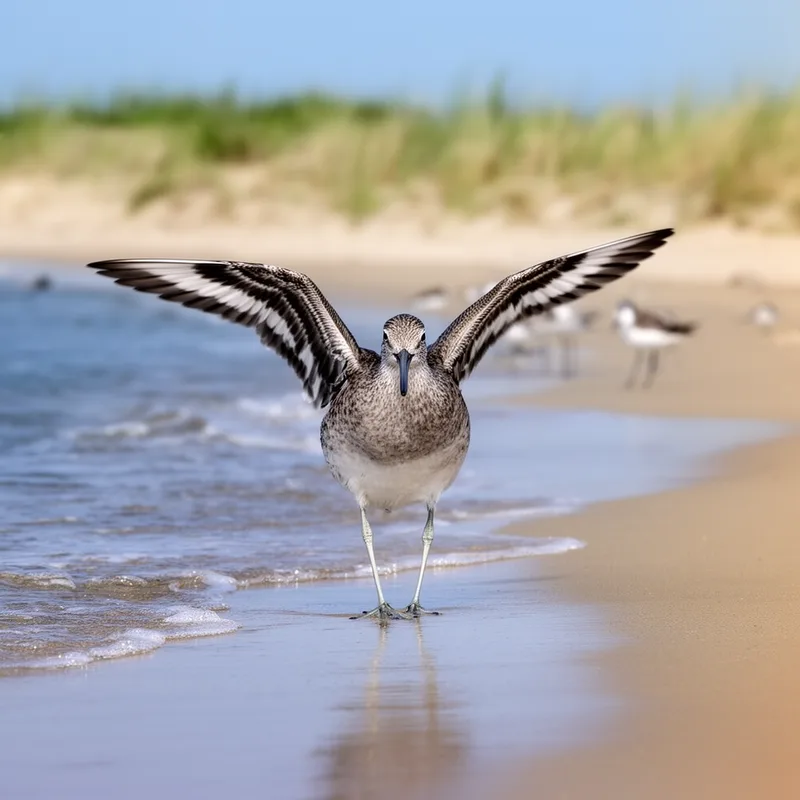
Catoptrophorus semipalmatus
- noun
- /ˌkætəpˈtrɒfərəs ˌsɛmɪˈpɑːlmətəs/
- Specialized
- The Catoptrophorus semipalmatus is easily recognized by its striking black-and-white wing pattern in flight.
Examples
-
During migration, large flocks of Catoptrophorus semipalmatus can be seen along the Atlantic coast.
-
Researchers observed the nesting habits of the Catoptrophorus semipalmatus in coastal marshlands.
-
The Catoptrophorus semipalmatus is often seen near coastal wetlands.
-
Have you ever spotted a Catoptrophorus semipalmatus in the wild?
-
During migration, large flocks of Catoptrophorus semipalmatus can be seen along the Atlantic coast.
-
Researchers observed the nesting habits of the Catoptrophorus semipalmatus in coastal marshlands.
-
The Catoptrophorus semipalmatus is easily recognized by its striking black-and-white wing pattern in flight.
Synonyms


 1
9.9
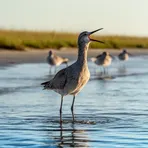
A large shorebird with gray feathers and a loud call along eastern and Gulf coasts
Surface Forms
Morphology
Catoptrophorus + semipalmatus
This is a Latin binomial (scientific) name whose parts are not ordinary English words and do not transparently compose to the common name 'willet'. Even if a learner recognized Latin elements like 'semi-' and a root suggesting 'webbed', that would at best hint at a physical trait (partly webbed feet) and would not allow them to identify the species or the meaning 'a large North American shorebird'. Because the overall referent is a taxonomic label rather than a compositional phrase, it is not derivable from the constituents and is opaque to B1 learners.
Etymology
Catoptrophorus semipalmatus comes from old Greek and Latin words. Catoptrophorus means 'mirror-bearer' because the bird shows a bright white patch on its wing that flashes like a mirror in flight, and semipalmatus means 'half-webbed' for its partly webbed toes, so the name helps you picture the willet.