
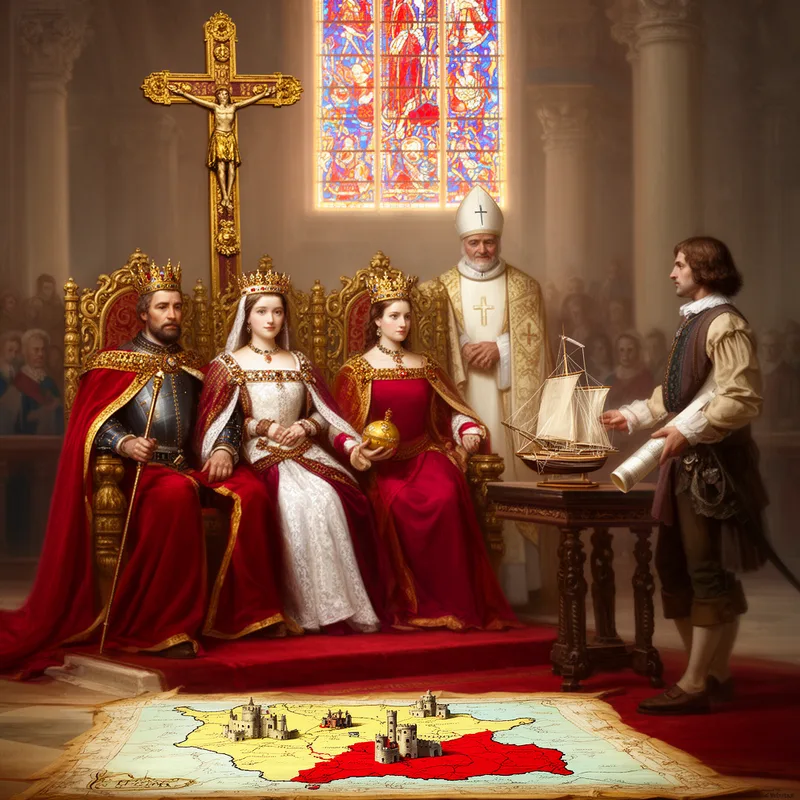
Catholic Monarchs
- proper noun
- The Catholic Monarchs united Spain through their marriage and shared rule in the late 15th century.
Examples
-
In 16th-century Spain, following the end of the Reconquista of the Iberian Peninsula in 1492, Muslims and Jews were persecuted by the Catholic Monarchs and forced to convert to Christianity or face expulsion.
Blog text (27) -
He also describes the Plaza de Bivarrambla (1:55), where celebrations and tournaments took place, first under Moorish occupation and later under the Catholic Monarchs.
Academic text (1997) -
The Catholic Monarchs became the mythic symbol of all that had been right with Spain.
Academic text (1991) -
Ortega, for his part, attributes popular support for the Catholic monarchs to the enthusiastic collaboration they demand in the national project of unifying Spain.
Academic text (2004) -
One of the principal historical characters in this play, set in the time of the Catholic Monarchs, is the Maestre de Calatrava, Rodrigo Tellez Giron.
Academic text (1991) -
(n2) Pulgar continued to serve the Catholic monarchs as a secretary and diplomat until shortly before 1479, by which date, possibly because of his criticism of the Inquisition, he was no longer at court.
Academic text (2004) -
The picture that Lope paints of the Gran Duque's distant relative, the Maestre, remains nonetheless ambiguous because he and his Order stand in direct opposition to the Catholic Monarchs.
Academic text (1991) -
Historians often discuss the policies implemented by the Catholic Monarchs during the unification of Spain.
-
The reign of the Catholic Monarchs marked a significant turning point in Spanish history.
Synonyms

Married king and queen who ruled Spain in the late 1400s and sponsored Columbus's voyages
Surface Forms
Morphology
The phrase is compositionally built from 'Catholic' (relating to Catholicism) + 'monarchs' (rulers), so a B1 learner who knows those words can readily infer it means rulers who are Catholic. Although as a historical proper name it specifically denotes Ferdinand and Isabella, that specific referent is additional encyclopedic knowledge and does not make the basic meaning unpredictable.
Etymology
The title Catholic Monarchs was given to Ferdinand and Isabella after the pope praised them for defending the Catholic Church. So Catholic shows their support for the church and Monarchs means 'kings', which is why we call these rulers the Catholic Monarchs today.

